


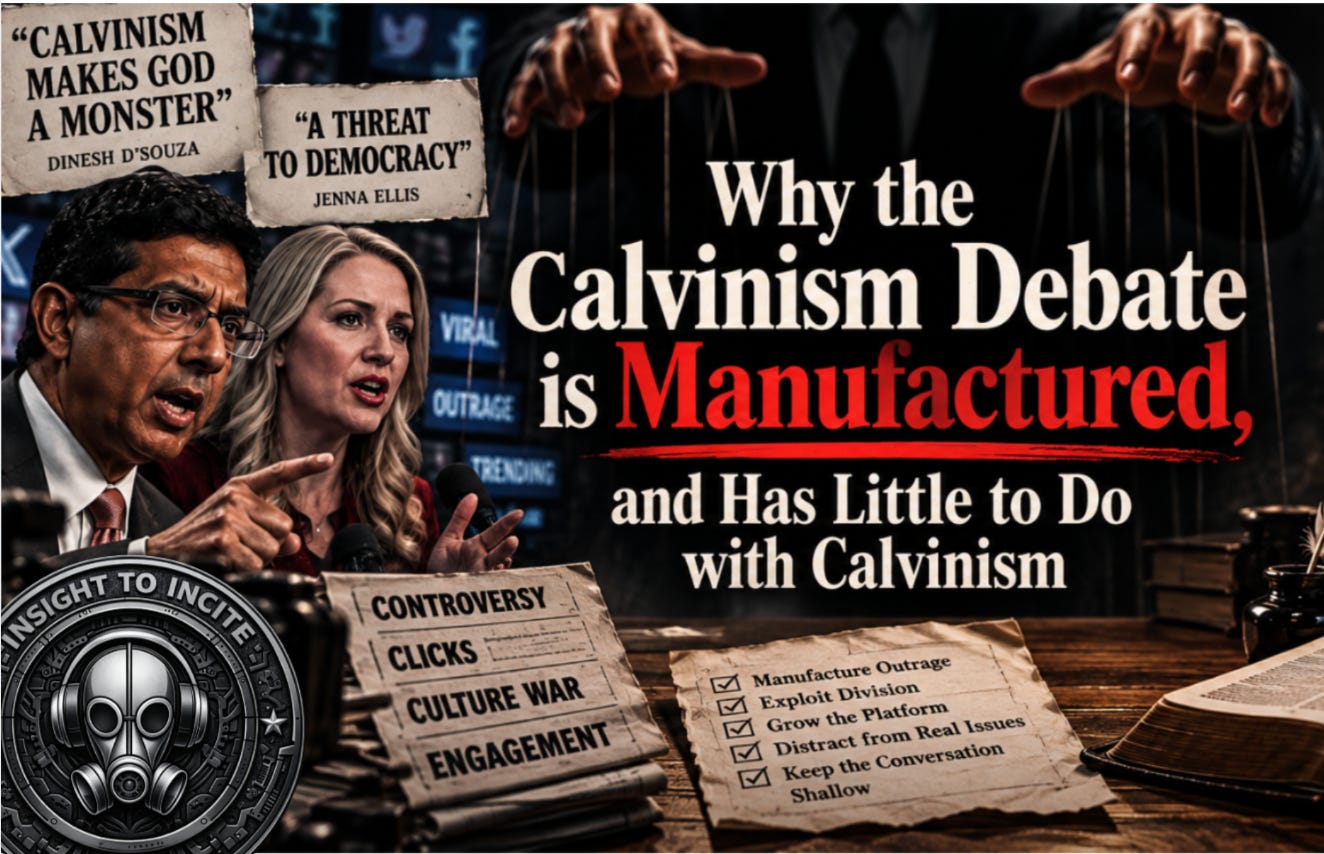
The Calvinism wars are suddenly back, but I don’t think this fight is really about Calvinism. After watching the controversy develop for weeks, I finally noticed the pattern behind both the people attacking the Doctrines of Grace and the strange silence of the Reformed institutions that once would have rushed to defend them. The explanation runs through the Reformed Resurgence, the rise and collapse of New Calvinism, and a generation of Protestants it accidentally trained to keep following the Text into places their old teachers never expected them to go. The people picking this fight have noticed something real. I think I figured out why.
The debate about Calvinism is suddenly everywhere, which meant - as someone whose professional job it is to explain things - I felt a charitable Christian obligation to explain why that was happening. There was only one minor obstacle. I had no idea why. What was apparent to me from the beginning - and I said so on X - is that this is not a normal, organic eruption of the Calvinism wars, where some Baptist discovers Romans 9 on Tuesday and has ruined Thanksgiving dinner for everyone just two days later. Something about it felt very, very manufactured. I’ve been watching it for about three weeks now, trying to make sense of why now.
The same arguments were appearing in the same corners at roughly the same time, pushed by people whose principal theological obsession had not previously been the finer points of unconditional election. In fact, it’s not Leighton Flowers or someone else who has turned hating Calvinism into a cottage industry. This round is different: the less likely someone is to grasp the subject, the more likely they are to try to take God’s Sovereignty to task. So I did what Polemics Santa does. I watched. I listened. I resisted the temptation to have an opinion for several minutes, which required enormous personal discipline, and kept staring at the pieces until the pattern finally appeared. Now I know why this is happening.
DINESH DE’CONTROVERSY
It seems Dinesh D’Souza and I are predestined to keep arguing about theology, whether a moderator is present or not. Six weeks ago, I was sitting across from him arguing about Abraham, Israel, Covenant Theology, and whether Jesus Christ is actually the point of the promises made to Abraham. That did not go well for Dinesh. Now he has recovered sufficiently to pick another theological fight, and by some marvelous providence he has managed to land squarely on another doctrine I happen to believe.
This time it is Calvinism. Dinesh has spent the last few weeks telling his millions of followers that predestination contradicts Scripture, makes God monstrous, makes unbelief God’s fault, and generally requires Christians to perform theological gymnastics to avoid the plain meaning of the Bible. Jenna Ellis, John MacArthur’s infamous attorney, has joined the festivities. Leighton Flowers has naturally appeared because somewhere in America a Calvinist was mentioned three times into a bathroom mirror. The first two have apparently only learned what they think Calvinism is sometime in August.
But, before anybody gets nervous, let me get the disclosure out of the way. Yes, I am a Calvinist. No, this is not a post about why Calvinism is right. I am not turning I2I into a five-point Substack, and your inbox is not about to become a steady stream of 4,000-word explanations of the Greek word for “draw.” My non-Calvinist subscribers may safely remove their hands from the unsubscribe button. Seriously. Don’t do that. I’m going somewhere with this, and it’s not to call you a heretic. I’ve been writing here for 2 years, and aside from one post explaining how Calvinism was used in the SBC and broader evangelicalism to smuggle in Social Justice, I haven’t written about it. Hopefully I go that long without writing about it again.
Truthfully, I hardly fly the Calvinist flag at all anymore. My theology has not changed, but my enthusiasm for the jersey certainly has. I remain a monergist and believe what Calvinists have historically believed about man’s inability and God’s sovereignty in salvation. But “Calvinist” eventually became something considerably larger than a theological adjective. It became an evangelical brand with conferences, celebrities, publishers, seminaries, approved ministries, approved opinions, approved enemies, and enough institutional baggage to require its own carousel at the airport. Calvinists are also famously jerks. One of the most-read articles ever written at Pulpit & Pen was inadvertent SEO clickbait, and I didn’t intend it to be. It was simply entitled, “Why Are Calvinists such jerks?” It turns out enough people ask Google that question regularly that it made that article pop in search results, and little by little its views eclipsed almost any other article at the Rolex of Polemics Blogs. The point is, we aren’t imagining it. There are reasons for that, which are not the point of this article. Ask me later.
Years ago, being a Calvinist was enough to place you into an elite fraternity of people united about defending God’s sovereignty. We all looked at each other as if we were on the same team. I’ve often recalled how my first criticism of Russell Moore was met with a high-profile blogger associated with Phil Johnson reaching out via phone to urge me to reconsider, because “Moore is a Calvinist. He’s solid. This will ruin you.” I assured him, I didn’t care what Russell Moore was, that he was not solid, and I have an indomitable disinterest in self-preservation. But that lie - that Calvinism is insurance against other trash theology or compromise - was a darned successful one for a decade, and because of it, untold damage was brought into evangelicalism through Calvinists ranging from Albert Mohler to Mark Dever to Tim Keller to Ligon Duncan, and many more.
I have already written the post-mortem on that mess, mentioned above, An SBC Post-Mortem: New Calvinism Was the Trojan Horse They Said it Was. The Reformed Resurgence became New Calvinism, and New Calvinism provided an astonishingly effective delivery system for social justice and liberalizing ideas inside conservative evangelicalism, like an IV into the veins. The serious Bible guys spent years building theological credibility, which made their institutions excellent places to launder ideas that would have caused ordinary evangelicals to reach for the eject button if those ideas had arrived under their original labels.
But here is the part that should not be lost. The Reformed Resurgence was not fake. Whatever eventually climbed aboard the train, the train was real, and it carried many genuine converts to Reformed theology. It began years earlier, when Ian Murray’s Banner of Truth planted the seeds by putting Puritan and Non-Conformist books and pamphlets into the hands of modern pastors. Others, like Chapel Library and more, did the same. So it started legitimately, and not by manufacture. Then, young evangelicals discovered Sproul, Piper, MacArthur, Edwards, Spurgeon, the Puritans, the Reformers, and, inconveniently for everyone involved, started reading their Bibles like they expected to find answers in them. And they did.
So I watched Dinesh’s newest crusade with some amusement. I watched Jenna Ellis pile on, starting by making fun of me on X for alleging John MacArthur had ever shut his church for COVID (fact-check: he opened it only after it became clear COVID was overrated as a killer, while at first condemning those of us who remained open). I watched the familiar accusations against Calvinism come rolling out of theological storage, looking almost exactly as I remembered them from twenty years ago. But I still couldn’t figure out how it got wind.
But then Polemics Santa noticed something last week, and I figured it out. The interesting story was not who was attacking Calvinism. The interesting story was who wasn’t defending it. And that’ll tell you what you want to know.
THE DOGS THAT DIDN’T BARK
James White responded, of course, because James White would debate a parking meter if it mistranslated the aorist tense. He has addressed Dinesh repeatedly, devoted a Radio Free Geneva to the renewed Calvinism controversy, and tangled with Jenna Ellis and Leighton Flowers along the way. That’s what he does, besides yelling at young men to “sit down and shut up.” But only a scattering of smaller Reformed writers and ministries have answered as well. So a Calvinist response has emerged. But that is what made the other silence so loud.
Where is GraceLand? Where is the G3 Corpse? Where are the old gatekeepers of conservative Reformed evangelicalism who once could detect an Arminian three counties away? Where are the ministries that spent twenty years teaching us that the doctrines of grace were hills worth dying on? I am not suggesting that every Calvinist with a podcast is obligated to answer every stupid thing posted on X. I am observing that one of the most famous conservative Christians in America has spent weeks publicly kicking Calvinism in the teeth, and several institutions built largely by, for, and around Calvinists have shown remarkably little interest in joining the fight.
That’s especially strange because they are not otherwise hiding under their desks. These people still argue on the Internet. They have opinions about Christian Nationalism coming out of every bodily orifice. They can find Joel Webbon with the speed and precision of a heat-seeking missile. The slightest whiff of Stephen Wolfe can still send half of Reformed evangelicalism scrambling for the emergency podcast equipment. The machinery works just fine. It simply does not seem particularly interested in firing in this direction.
Then I noticed who was standing in the direction of fire.
If you were to start making a list of the most recognizable Protestant Christian Nationalists, particularly the men who have become radioactive to the old evangelical establishment, something funny happens. You keep finding Calvinists. Reformed Baptists, Presbyterians, CREC guys, confessional Protestants, postmillennialists, a few historic premillennialists, and assorted Reformed troublemakers are all over the place. They disagree with one another about plenty, sometimes loudly, but the gravitational pull toward Reformed soteriology is impossible to miss. It’s almost a movement within a movement.
And suddenly the newest Calvinism controversy looked considerably less random.
The people taking swings at Christian Nationalism have noticed the same thing. They may not understand why the correlation exists yet, but they have noticed it. If you spend enough time shooting at Christian Nationalists, sooner or later you begin to wonder why you keep hitting Calvinists. Eventually somebody gets the bright idea to move the sights upstream.
That also makes the silence from the old Reformed establishment considerably easier to understand. These institutions have spent the last several years telling everyone that the Christian Nationalists are dangerous, embarrassing, extreme, unbalanced, unchristian, or some combination thereof. Now, some of their ideological allies have begun attacking the theology overwhelmingly represented among the very men they have been attacking. So what exactly are the old Calvinist gatekeepers supposed to do with that?
CLICK HERE FOR THE LINKS USED TO RESEARCH THIS ARTICLE, AND MORE FOR YOUR OWN FURTHER STUDY.

They can rush forward to defend Calvinism and discover that they have climbed into the same foxhole as the Christian Nationalists. They can explain that Dinesh and company are terribly wrong about predestination while reminding everyone that the predestinarian barbarians standing beside them are still terribly wrong about nearly everything else. Or they can suddenly develop an uncharacteristic interest in minding their own business. By gosh, I think we’ve found it. The people who only care about theology don’t really care about theology at all, at least, if it requires sullying themselves in a fight alongside the XNats. They’ll sit this one out.
But noticing the correlation only creates the more interesting question. Why are so many of these troublesome Christian Nationalists Calvinists in the first place? Have you ever thought about it? Boy, I have. For that answer, we have to go back about twenty years.
WE ARE THE SONS OF THE REFORMED RESURGENCE
To understand the correlation, you have to remember what happened to an entire generation of Protestants beginning around the turn of the century. We didn’t just wake up one morning with an inexplicable affection for dead Europeans and five-point flowers. We were caught in the Reformed Resurgence, and for all the institutional rot that eventually grew out of it, the theological revival underneath it was very real, as I said above. For a while, it was even beautiful to behold.
A generation of young Christians encountered doctrines many of us had never seriously considered. Some of us had been taught that Calvinism was a cult. My first ministerial “boss,” the senior pastor, asked me if I had heard of “that newfangled thing, Calvinism,” and I assured him that yes, I had, and that no, I wasn’t. We were warned that predestination made men robots, and that Calvinists believed God arbitrarily threw babies into Hell and turned down sinners who were desperately trying to get saved. Then somebody handed us R.C. Sproul. Somebody introduced us to Spurgeon. We found Edwards, the Puritans, the Reformers, and old confessions written by men who seemed considerably less embarrassed by their Bibles than most of the Christianity we had encountered. And then, something terrible happened. We started checking their work against the Scripture.
That really wasn’t my journey, though. Mine was: I managed a car lot and left ministry long behind because it couldn’t pay the bills for my growing family, and a man in my younger twenties with two small children had responsibilities greater than sermon preparation. I was also bored out of my mind. So, at work, I read the Bible on the computer every day, and eventually came to Romans 9. I read it. I know I had read it before. I had never missed a Sunday in church for anything but a debilitating flu. I had to have heard sermons on Romans 9 before. Right? Right? So I read Romans 9 every day for six months, trying to find every-which-way-out-of-it meaning of what it was plainly saying. I didn’t cross-reference it with other Scriptures. That came about six months later. I didn’t read the Puritans, the Reformers, or “the dead guys.” I was trying to find a way out, and lo and behold, couldn’t find an escape hatch.

After six months, I started to cross-reference the subject in the Bible. Mercy sakes. It was everywhere! And at some point along the way in that journey, suddenly, everything made sense. And everything else seemed like insanity. Only then did I consult anyone living or dead to see if they had come to the same conclusions, and they had. Like so many my age in that era, the “anyone” I consulted with was Driscoll, Chandler, and Piper. It took me about two years to find the problem with them, but their problem wasn’t their soteriology. It was pretty much everything else. Nonetheless, it was a portal to another world in which - and this was by far the most attractive part to me - I didn’t have to do God’s PR any more.
One reason I was perfectly content leaving ministry was that I had started doing sales and got an unintentional lesson in what was wrong with evangelicalism. In my sales training, I discovered it was exactly how I was trained to sell Jesus to sinners in Bible College and NAMB church-planting training. Make the gospel a product. Act like Jesus’ PR guy. Promote his good qualities. Overcome objections to the attributes of God people naturally do not like by denying or just ignoring them, and never introduce the objection yourself. Questions like theodicy (why bad things happen to “good people”) always terrified me. And all of a sudden, I had a God I didn’t have to make excuses for. And that’s a God that I suddenly very much wanted to worship, unlike ever before. Becuase that was a God who didn’t save me because He looked down the corridors of time and saw that I would be receptive to Him. He gave me faith, opened my eyes, and dragged me by the scruff of the soul to bend beneath his presence. It made me understand my own salvation better, and to this day, that revelation changed me almost as much as salvation itself.
As I was having that experience in the 00s, millions more my age were, too, all at the same time.
That is the part of the Reformed Resurgence people forget. Calvinism did not spread merely because John Piper was compelling, Sproul was brilliant, or MacArthur had a radio program. Those things put the doctrines in front of people, but they also sent people into the Text. And once there, an enormous number of us encountered the same deeply irritating problem. The Calvinists appeared to have a point.
I’ve always said that there is a grief cycle involved in embracing the Doctrines of Grace. First comes, “I hate this, and it cannot possibly be true.” Then comes, “I think this might be true, but I still hate it.” Eventually you arrive at, “Fine. It is true, so I have to accept it.” Then, sometime later, the final indignity arrives. You embrace it, because you finally understand that if God actually said something, the problem was never that His revelation needed to become more agreeable to you. Your sentiments needed correction.
Obviously, not every Calvinist has that testimony, and people do leave it behind. Rarely. I am describing something recognizable enough that Calvinists laugh about the “cage stage” because we have watched the process happen thousands of times. The convert discovers the doctrines, fights them, becomes convinced by them, and then spends six unbearable months wondering why everyone else has not yet noticed the eighteen verses he discovered last Tuesday.
But something else happened during that conversion that was far more consequential than changing our minds about election. Long before Calvinism forced us to wrestle seriously with predestination, it forced us to wrestle with sufficiency and inerrancy. It confronted us with the question beneath nearly every theological question: What happens when the Text appears to say something I do not want it to say?
Reaching that second stage was fairly quick. I was taught, “God says it, that settles it,” growing up in the inerrancy battles of the Conservative Resurgence in the SBC, in which the nation’s largest denomination went to war over whether or not the Bible is infallible (mostly centered on female preachers). On the conservative side of the resurgence, inerrancy was catechized into my soul, despite no one ever using the word “catechized.” That was established truth in my family and church. I even called my childhood pastor and asked, “Did you know this?” He laughed and said yes, and he believes it too. Then, I asked him why he never told us. His answer? “It’s controversial.” I was blindingly angry at him and hung up the phone. Are you going to tell me the Bible is 100% true and then omit a chapter? This is beautiful, and you hid it from me, and I’ve been sitting here wrestling with the Scripture for a year when I should have known this at seven.
For me, the consequences escaped soteriology almost immediately. Around the same time I became a Calvinist, I became convinced of a plurality of elders and church discipline. Calvinism did not require either conclusion as a logical consequence of unconditional election. The connection was simpler. They were in the Bible, and I had just spent months learning that pretending not to see inconvenient passages was not an acceptable method of interpretation. Those were there, too, and in 24 years as a Southern Baptist, I had never seen either.
That lesson is difficult to contain once learned. If Romans 9 does not require my permission, neither does Matthew 18. If my church tradition must surrender when the Text contradicts it, so must my political tradition, cultural assumptions, sentimental preferences, and inherited ideas about what Christianity is permitted to require in public.
We were learning to lose arguments with our Bibles. Twenty years later, some of the sons of the Reformed Resurgence eventually opened theirs and started asking what God had to say about the civil magistrate, gender, Biblical Justice, kinship, and more. And now, here we are.
Why did it take 20 years? I’m afraid some might hear my thesis and think I’m tying two unrelated things together. I’m not, I assure you.
The Reformed Resurgence produced thousands of people trained to ask uncomfortable questions and then keep reading after the comfortable answer disappeared. We applied that habit to ecclesiology, worship, church government, discipline, marriage, masculinity, family, education, and eventually the relationship between Christ and the nations. The doctrines did not all arrive in one package, and Calvinism does not logically entail every conclusion that followed. What traveled from one subject to another was the method.
Show me the Text.
That sentence does not allow him to exempt the traditions he likes, the political arrangements he inherited, or the assumptions his civilization considers self-evident. If Scripture gets to overturn his conception of free will, why would liberalism receive immunity? If God’s sovereignty is permitted to offend modern man in salvation, why must God’s authority suddenly become carefully housebroken when the subject turns to civil government?
Eventually, some of us began asking questions that our Reformed teachers had been perfectly happy for us to ask everywhere else. Does Jesus now possess authority over nations? Are kings and rulers morally accountable to Him only as private individuals, or as rulers? Does the civil magistrate administer some mysterious morally neutral territory where God’s law has no jurisdiction? Did religious pluralism come from the Bible, or did we inherit it from somewhere else and then teach ourselves to read Scripture around it?
Those questions did not require us to abandon what the Reformed Resurgence taught us. They required us to keep going. Now, twenty years later, that Reformation is over. We planted the churches and put Calvinism in our doctrinal statements. Or, more accurately, just adopted the old doctrinal statements from the mid-1800s through the advance of Dispensationalism, because Calvinism was already in them. Now, our kids have grown up in it, and it’s no longer sensational. Those churches don’t fight about it. It’s just doctrine to us. My kids don’t think it’s weird. It’s all they’ve ever known. It used to be that Calvinists had to be “smoked out,” with numerous articles circulating online about how to get a pastoral candidate to be honest about it. It’s no longer controversial, at least not like it used to be. And if it’s a problem, he starts a new church, and Reformed believers come running to join. We live in completely different times now.
So now what is there to reform, anyway?
AND THEN WE GOT TO THE MAGISTRATE
Eventually, somebody asked the question that caused everyone to start throwing furniture. If Christ is Lord over everything else, what exactly are we supposed to do with Caesar?
If you appreciate my work, please grab a premium subscription for only $8 to access exclusive content (like the rest of this article). It’s how I provide for my family, so I sure appreciate it. Act now, and get a 33% discount for an annual subscription - way less than that.
If you don’t do subscriptions, consider a one-time gift by clicking here.


