


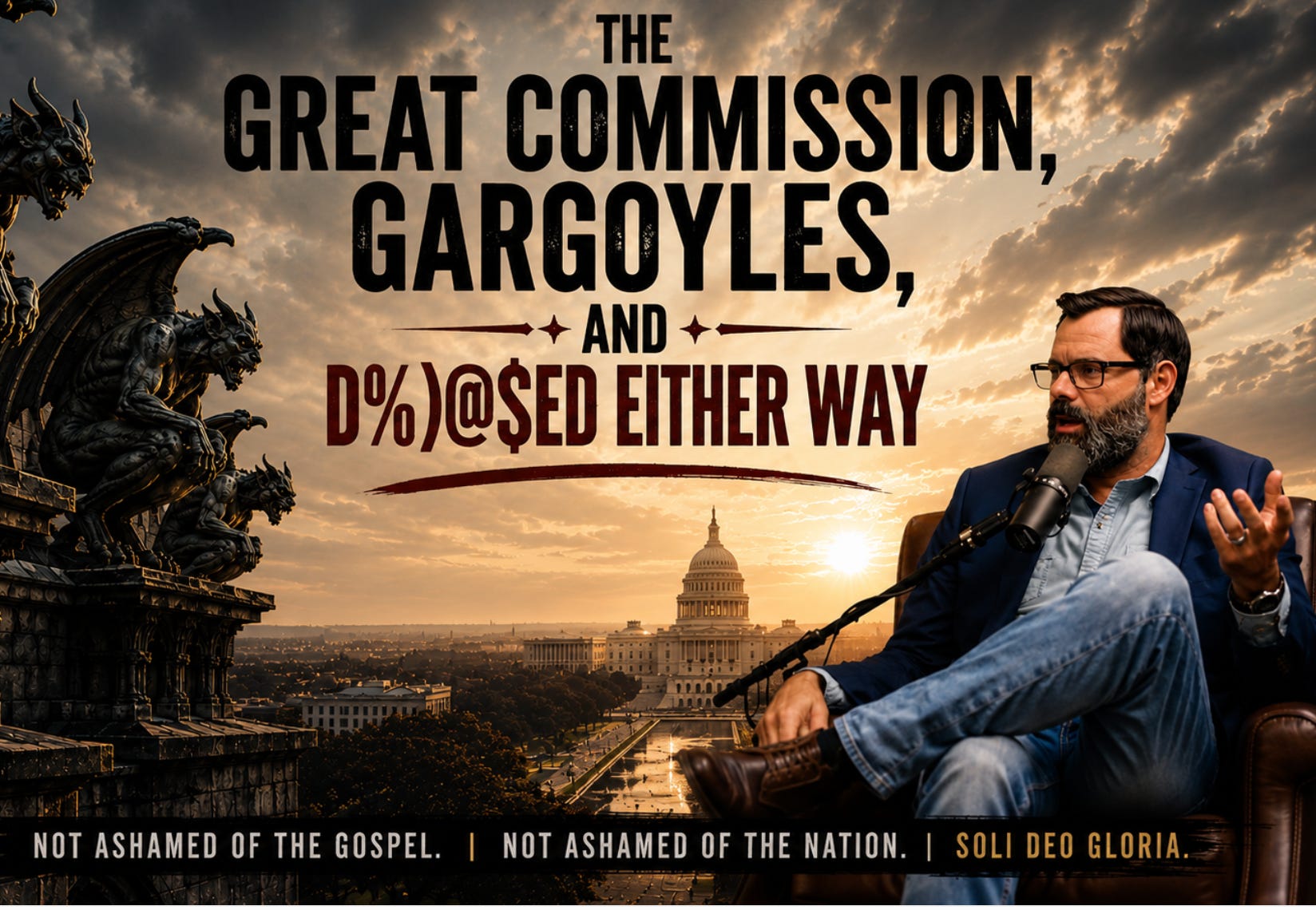
In all my years doing polemics, I have never seen a man so many people are so desperately waiting to anathematize as Joel Webbon. They sit like gargoyles on the roof, eyes fixed on every video, ears pitched toward every podcast, waiting for one crooked syllable to finally tumble out of his mouth. Just one will do. One clean, unmistakable heresy, and at last they can descend from the parapets, pronounce the long-awaited anathema, and make their denunciations to the raucous applause of respectable evangelicalism. They can’t just say, “He’s too conservative” or “He’s taken the Bible too far.” Revealing their real motivations would ruin them as much as him. So instead, they cross their fingers and hope that this might be the day they can finally blow the whistle and throw their anathema flag on the field. Their verdict has been written for years. They just need one good opportunity.
Oh, don’t get me wrong. Plenty of people have already tried to “Farewell, Rob Bell” him. The problem is that every attempt has ended less like an ecclesiastical trial and more like a neighborhood HOA trying to excommunicate somebody for an unauthorized mailbox. The denunciations arrive with great solemnity, the theological equivalent of black robes and tolling bells, only to produce more eye-rolling and laughter than gasps. Webbon says something outrageous, somebody announces that the Gospel itself is now in mortal danger, everyone checks what he actually said, and three days later the heresy hunters quietly climb back onto the roof to wait for the next video, tail tucked between their legs.
I’ve had a half-dozen people or more, and I kid you not, openly express frustration that, “with you around keeping his theology from going native,” Webbon is less likely to finally say the one heretical thing they can finally cast him into the outer darkness for. Think about the pathology of that for a moment. They are not worried that Joel might fall into heresy. They are disappointed that he hasn’t. They want the theological car wreck because they have already purchased tickets to the funeral. It’s a perfect relationship, Webbon and his critics. They are voyeurs looking constantly through the window, and he is a theological exhibitionist. In other words, he’s honest.
For the record, I do not manage Joel Webbon’s theology, police his vocabulary, approve his opinions, or stand behind the camera frantically waving cue cards reminding him of historic Christian doctrines. You’ve seen the man. Trying to manage what comes out of Joel’s mouth is God territory. To his credit, at the least, he’s honest. Webbon is comically unsuited to concealment.
Because, much as they hate it, and as they hate him, Webbon’s theology is stubbornly orthodox. His doctrine is irritatingly pristine. Nine times out of ten, the supposedly dangerous opinions pouring out of his mouth were already said by one of the Reformers whose faces decorate his critics’ coffee mugs, or a Church Father they named their dog after. The great scandal is frequently not that Webbon has departed from historic Christianity, but that he has wandered outside the remarkably narrow boundaries of what modern American evangelicals have decided historic Christianity is allowed to say in the 21st century. They desperately need Webbon to be a heretic, and he stubbornly refuses to participate.
AMERICA AFTER TRUMP
That makes the latest attempt particularly embarrassing. After years of waiting for him to finally step on a theological landmine, his critics believe they have caught him corrupting the Great Commission. There is just one unfortunate complication for the prosecution: they have picked a fight over elementary Christian doctrine that they clearly do not understand. Again.
Their latest opportunity arrived through NXR’s upcoming conference, Christ Is King: America After Trump, scheduled for November in Dallas. Its stated premise is aggressively practical: Christians should be prepared for what comes after the current political order. I couldn’t agree more. Much of what you see in the news is steered by the Beltway establishment’s agenda to shove whatever is left of MAGA 1.0 down the memory hole and rid Washington for good of things that Trump once stood for, and more importantly, the populist revolt that put him there in the first place.
Trump was always less important than the political earthquake underneath him. Millions of Americans had concluded that the people running their country hated their borders, squandered their money, exported their jobs, despised their religion, flooded their communities with foreigners, shipped their sons overseas to fight wars nobody could explain, and then called them stupid, racist, backward, or dangerous whenever they complained. The establishment’s great project now is not merely figuring out what happens after Trump. It is making sure Trumpism dies with Trump.
That means sanding every rough populist edge off the Right until the Republican Party becomes safe for its old owners again. Keep the rallies and merchandise if necessary, but lose the immigration restriction, economic nationalism, hostility to foreign wars, distrust of the intelligence apparatus, contempt for the donor class, skepticism toward multinational corporations, and especially the dangerous notion that elected officials should prefer the interests of the Americans who elected them over some collection of abstractions cooked up in Washington think tanks.
That is why America After Trump is the right decision. Eventually Trump will exit the stage, one way or another, and the people who spent a decade waiting him out intend to be standing there with a broom when he does. The question is whether the millions of Americans awakened by the populist revolt quietly return to their couches, or whether somebody builds institutions, organizations, churches, media, political networks, and a durable Christian political philosophy capable of carrying that revolt into the next generation. That’s what the conference is about. The other side - the NeoCons, the Israel Lobby, Bill Kristols and David Frenches, the Ben Shapiros and Mark Levins, the Ted Cruzes and whatever Lindsay Graham’s sister’s name is - are preparing for a world without Trump, and if they have anything to do with it, without Vance.
Christians should be ready, too. That’s the premise of America After Trump.
The speaker list deliberately mixes pastors with politicians, writers, comedians, and cultural figures because NXR is interested in what Christians should actually do in the world, not merely what pastors should preach on Sunday morning.
That posture grows out of NXR’s broader opposition to what I have called Pioustrategic Uselessness, the evangelical habit of treating “preach the Gospel” as the approved answer to every question, including questions that were never about how sinners are justified. A border crisis needs border enforcement. Murder needs a magistrate. Children need fathers. Schools need teachers. Nations need laws. None of this diminishes the Gospel’s exclusive power to save sinners. It merely acknowledges that God has given Christians more than one job to do after breakfast.
Hear me out on this. Yes, many of the world’s problems would miraculously be solved if everyone became a Christian tomorrow. Well, maybe not tomorrow, because it would take a while for sanctification to progressively turn them into to better people. Eventually, anyway, a mass conversion event would take care of a bunch of issues. But because we don’t live in la-la land, there are other realistic solutions that can do the world a lot of good, even if they stop short of justifying people before a righteous God. We are just crazy enough to think that border walls and mass deportations are a solution to mass migration, tall trees and short ropes are a solution to violent criminals, a navy is the solution to an approaching army, fathers are a solution to fatherless homes, and barbers are a solution to man-buns.
TWENTY links are provided from theological resources explaining that the purpose of the Great Commission goes well beyond evangelism.

Call us crazy. Practical problems have pragmatic solutions. Jesus is the answer, yes. But not the question of “What should you do to someone breaking through your bedroom window?”
None of those solutions raises a dead sinner to spiritual life. Neither does a fire department. Yet when your kitchen is burning down, hosting an evangelistic crusade on the front lawn is not evidence that you have lost confidence in the power of the Gospel. It means you understand that God has provided different means for addressing different problems. The Gospel answers the greatest problem a human being has. It does not answer all of them. That’s why I have a gun within reach of my bed. And my steering wheel. And my recliner. And my toilet.
We have bears, and I’m paranoid. Don’t judge.
And this is where the latest heresy hunt became interesting. Webbon’s critics objected that activities such as building Christian schools, pursuing Christian political power, reforming institutions, and ultimately seeking Christian nations cannot properly be called Great Commission work. The apostles were commissioned to evangelize, they tell us, not establish governments. The Great Commission means evangelism. Heck, it’s synonymous with evangelism. Once Webbon puts Christian civilization underneath the Great Commission, the accusation goes, he has confused political reconstruction with the Gospel and wandered into dangerous theological territory.
Mike Winger, the charismatic clean-up artist masquerading as a discernment minister (who I’ve written about here), accused Joel of teaching a false gospel. Why? Because he said that building Christian nations was Great Commission work.
At last! The moment has arrived. Fetch the church fathers. Warm up the anathema machine. Somebody alert the discernment bloggers! Whistle at the gargoyles and tell them it’s time to pounce. Warm up the denunciations! Except there is one small problem.
They’re wrong.
THE GREAT COMMISSION
The Gospel, evangelism, and the Great Commission are not synonyms. The Gospel is the good news that Christ died for our sins, was buried, and rose again (1 Cor. 15:1–4). Evangelism is the proclamation of that good news to sinners. The Great Commission is the considerably larger command Christ gave concerning what His people are to accomplish in the world.
And Jesus did say merely, “Go evangelize.”
I know, I know. This is the verse they taught us on Missionary Sunday. Matthew 28 went on the projector somewhere between the slideshow of smiling African children and the presentation about Lottie Moon, William Carey, and whichever missionary family your church supported for seventy-five dollars a month. The Great Commission became evangelical shorthand for foreign missions, and foreign missions became shorthand for evangelism. “Go ye therefore” meant get on an airplane and go do missions. Because of that word-training, we came to think of it as an evangelism thing.
I was about 22 years old when a North American Mission Board missionary told me while on mission in Sao Paulo that the Great Commission was not principally a command to evangelize. I thought he was nuts. If there were ever an inappropriate place to question the evangelistic interpretation of the Great Commission, surely it was while surrounded by missionaries doing missionary things. The association had been drilled into me so thoroughly that his statement sounded almost self-refuting. But then I re-read it, which is what a lot of people need to be doing the last 24-48 hours. Becuase he was right.
Evangelism is obviously necessary to the Great Commission. But necessary is not the same as synonymous with. Evangelism is certainly in the machinery. But it isn’t the whole machine. It’s not the whole purpose. In fact, it’s the purpose of the Great Commission. It’s a prerequisite, not the purpose. And once somebody pointed that out to me, I couldn’t unsee it.
ALL AUTHORITY
The easiest way to settle an argument about the Great Commission is to actually read it. Matthew records Christ’s final command this way:
“Go ye therefore, and teach all nations, baptizing them in the name of the Father, and of the Son, and of the Holy Ghost: Teaching them to observe all things whatsoever I have commanded you” (Matt. 28:19–20).
But the preface, before it, is just as important to understand its meaning: “All power is given unto me in heaven and in earth.” That wording should clue us in to what follows. Before Christ says a word about going, discipling, baptizing, or teaching, He announces the jurisdiction under which the entire Commission operates. It’s not some power, or merely spiritual power, nor power specifically over the visible church. Not authority safely confined to Sunday mornings, personal devotions, and the interior life of individual believers. Christ begins the Great Commission by declaring His universal kingship.
Christ is King is the predicating assertion of the Great Commission. Remember that.
That is not decorative language Jesus tacked onto the front of a missionary motto. The word “therefore” connects His authority directly to the command: because all authority in heaven and earth belongs to Christ, therefore the nations are to be discipled. The scope of the authority establishes the scope of the mission. Christ does not begin by saying that He possesses authority over individual souls and then commission His disciples to collect individual souls from around the world. He announces His sovereignty every square inch of earth. Why? Because the Great Commission will require power and authority over every square inch of earth.
One of the strangest complaints routinely lodged against Christian Nationalists is that they seek political power. Whether Christian Nationalism is good or bad, biblical or unbiblical, prudent or foolish, regardless of that: Christians should seek political power. Political power is simply authority to govern, and there is nothing inherently wicked about possessing it. Power is not dirty. It isn’t seedy. Someone will write the laws, appoint the judges, command the military, collect taxes, determine immigration policy, regulate public institutions, and decide which conduct receives punishment and which receives protection. Christians must not cede that power to unbelievers. The first reason we must seek political power is that if we don’t, worldlings will.
Where did Christians get the idea that political authority is uniquely beneath them? They did not get it from a Christ who introduced the Great Commission by declaring, “All power is given unto me in heaven and in earth.” Christ does not regard earthly authority as intrinsically profane. Scripture calls the civil ruler “the minister of God” and that they wield the sword (Rom. 13:4). The problem is not that political power exists. The sword does not become less legitimate because a Christian holds it.
Every political order rewards certain behaviors, prohibits others, teaches them to obey someone’s commands, and then uses actual men with actual guns to enforce those conclusions. The question is who’s holding the guns. Christians should therefore have no embarrassment about wanting political authority exercised by Christians according to Christian convictions. The notion that seeking political power is itself suspicious should be discarded before that discussion even begins.
Christ is King, and politics falls under “Heaven and Earth” where Christ has authority. In fact, if I were Satan, the first thing I would do would be to convince Christians that Christ has no political or governmental authority. It sounds like advice from Uncle Screwtape.
If the Great Commission concerns nothing beyond privately converting individual sinners, why does Jesus introduce it by announcing His universal dominion? He is claiming authority over the very world into which He is sending His disciples. Kings are under that authority. Magistrates are under it. Fathers, merchants, judges, teachers, nations, and their rulers are under it. Caesar does not occupy some tiny unclaimed patch of earth accidentally omitted when Christ said all.
“Go ye therefore…”
Christ does not merely announce His universal authority and then change subjects. Because all authority in heaven and earth belongs to Him, therefore His disciples are sent into the world. Their going proceeds from His kingship, carries His authority, and serves the mission He is about to give them.
That also means Christianity is necessarily expansionary. Christ sends us outward. Christianity crosses borders, enters foreign cultures, confronts rival religions, establishes churches, teaches households, and presses the claims of Christ wherever human beings are found. The movement is centrifugal. Christ possesses the world, so His disciples are sent into it.
This is not conquest by the sword, but neither is it religious pluralism with a fish sticker. The Christian goes because Christ has authority over the place to which he is going and over the people he will find when he gets there. The missionary does not arrive asking whether Jesus may be added to the local collection of acceptable gods. He arrives announcing that the crucified and risen Christ is already Lord.
The Great Commission therefore begins with a King, proceeds with an invasion of missionaries, and operates on the premise that there is nowhere on earth where Christ does not have claim.
“…and teach.”
The KJV obscures the force of the command slightly because “teach” sounds like classroom instruction. The Greek is mathēteusate, from mathēteuō: make disciples, or more directly, disciple. That is the governing command of the Commission.
Jesus had perfectly good words available for preaching and proclamation. He does not use them here. He does not say “preach,” “proclaim,” “evangelize,” “make converts,” or even simply “make Christians.” He commands His followers to make disciples. Conversion is necessarily involved because nobody becomes Christ’s disciple without believing the Gospel, but conversion is not where the verb stops, because conversion is not the goal; it predicates the goal.
Evangelism brings sinners to Christ. Jesus does not commission His church merely to produce professions of faith and count raised hands. He commands the formation of people whose lives are increasingly ordered beneath His lordship. And Christ has already told us the scale upon which He intends that discipling to occur. The next words are not “as many individuals as possible.”
“…all nations.”
And now Christ gives us the object of the command: panta ta ethnē, or “all nations.” This is not a command to disciple as many individuals as possible. He does not even say, “Make disciples from every nation.” He commands His followers to disciple the nations themselves.

Some have suggested that the word used here references people groups, generally speaking. Or maybe ethnicities. Like Jesus is saying, “Go save Caucasians, and Africans, and Asians, etc.” But ethnos, while it could mean that in a different context, is not an ancient slang word for the modern missionary phrase “people group.” Scripture uses the word for nations in a corporate sense. In the Biblical context - when looking at the use of this word in Scripture - you see that it does indeed refer to the body-politic. For example, in John 11 when the Sanhedrin plots Christ’s assassination because they fear that Rome will “take away both our place and nation,” ethnos is the word it uses (John 11:48). The First Century Jewish Zionists were afraid Rome would remove their right to nationhood.
Likewise, Acts 17:26 says that God “hath made of one blood all nations of men” and determined “the bounds of their habitation.” It’s not just the people, but the people in the place where they reside. This is the context of literal nationhood. Biblically, a nation is a people occupying places, existing within boundaries, and living corporately in history. So the Great Commission is not imagining “White folk.” It’s imagining America, the UK, Australia, New Zealand. It’s speaking of “Black folk.” It’s speaking of Ethiopia, Haiti, and Nigeria.
Neither is Jesus saying to make disciples from among the nations. We know that for certainty, because the Bible has a thing for prepositions, and in the Greek language, they’re evident. In the Bible, when evangelism is in view, it speaks of the Gospel going to nations, or among nations, and redeemed people coming out of nations. Jesus, for example, says that “the gospel must first be published among all nations” (Mark 13:10). Matthew 24:14 says that the Gospel will be preached “for a witness unto all nations.” Revelation 7:9 describes the redeemed multitude gathered “of all nations, and kindreds, and people, and tongues.” When Scripture intends to describe Gospel proclamation, it speaks of people within the nation.
But Matthew 28 uses none of those constructions or prepositions. Mathēteusate takes panta ta ethnē directly as its object: Disciple all nations. Corporately.
Obviously, that doesn’t mean nations possess a giant collective soul, nor does national discipleship require every citizen to become a born-again Christian. We already understand corporate Christian identity everywhere else. A Christian household might still contain an unconverted child. A Christian school will likely contain an unbelieving student. A Christian church can contain a false convert. Corporate identity describes what governs and characterizes the body, not the secret spiritual condition of every individual within it.
So when Christ commands the discipling of nations, He’s not speaking of extracting individual converts from permanently pagan societies. The premise is that through the Great Commission, converted men will form Christian households, Christian churches, Christian schools, Christian customs, Christian institutions, establish Christian laws, and build Christian governments. A discipled nation increasingly orders its corporate life beneath the authority of the Christ who introduced the Commission by declaring that all authority in heaven and earth belongs to Him.
Jon Harris gave a neat response on Jeremy Boreing’s program: “You get a Christian nation by having Christians in that nation.” It’s a statement designed to poo-poo the work of Christian Nationalism, and it’s a perfectly good Jesus Juke and an excellent applause line because it quietly changes what the word nation means. Suddenly a “Christian nation” can only mean a nation in which every individual citizen is personally Christian, so that only evangelism can produce the intended result. It’s designed to stop all acts of potential usefulness, except evangelism. But nobody uses national adjectives that way anywhere else.
When the State Department speaks of an Islamic nation, nobody assumes everyone in it is Muslim. Saudi Arabia does not cease being Islamic because a Filipino Catholic works in Riyadh. We call a country Islamic because Islam publicly characterizes the nation, and its institutions, laws, customs, public morality, and official religious commitments bear an Islamic character. Likewise, we routinely speak of secular states without first proving that every citizen is an atheist. France can be a secular republic while millions of Frenchmen believe in God because secular describes the character of the political order, not the regenerated or unregenerated condition of every soul inside its borders.
Nobody is proposing justification by passport. The claim is that nations, like households, schools, universities, governments, and civilizations, possess a corporate character produced by what they publicly confess, honor, teach, prohibit, and institutionalize. And guess what! Evangelism is way easier, and way more productive, in Christianized nations. Building those Christianized institutions and civilizations does not save a single soul. But they are essential to the missionary endeavor. It’s much, much easier to tell people about Jesus when it’s not illegal to tell people about Jesus. It’s easier to get people to church on Sunday when blue laws exist (whether you agree with them or not). It’s easier to fund missions when the church is tax-exempt.
The preface to the Great Commission, Christ’s Kingship, starts with a statement of Jesus’ authority because authority is what’s needed to order a society toward the Word of God and the rule of Christ.
“Baptizing them…”
The people who have been brought under Christ’s discipling rule are baptized into the name of the Father, Son, and Holy Ghost. Nobody thinks Jesus intends somebody to lower France into a baptistry. Nations are discipled corporately, and baptized individually, as they come to faith.

This is also the closest thing in the Commission to an explicit reference to conversion, and even here evangelism is not actually commanded. Jesus does not say, “Preach the Gospel to them, and after they believe, baptize them.” It is presupposed. But why doesn’t He mention it explicitly? It’s because evangelism isn’t the point of the Great Commission. Hold up! It makes sense that He doesn’t mention evangelism (or the gospel) if evangelism isn’t the point. But WHY mention baptism then? It’s because baptism is about identity with Christ.
Follow the logic. Yes, baptism requires evangelism - true. But Jesus mentions neither the gospel nor evangelism. The reason is clear. Baptism is included with the rest of the Commission, because it is the individual’s public identifier with Christ. That’s what the Great Commission is about. It’s about the nation identifying with Christ. And on a personal level, the individual also identifies with Christ through Baptism. Baptism - like Christian laws - doesn’t mean the person is saved, necessarily. Baptism doesn’t justify. Baptism is an outward expression that the person belongs to Christ. In a similar vein, Christian laws and Christian order is how a nation identifies with Christ.
Further, the moment a pastor baptizes a believer, he is unquestionably fulfilling the Great Commission. But Baptism isn’t evangelistic. The pastor dunking the believer is not evangelizing them by submerging them. And yet, it is the Great Commission.
“…to observe…”
The objective is not awareness of Christ’s commands, but obedience to Christ’s commands. This is the clearest component of the Great Commission that shows it is not evangelism. No missionary arrives among unbelievers, pulls up his britches, and says, “First things first. Obey these commands.” You or I would tell that missionary to go home until he learns what the gospel is. We would rebuke Him for dereliction of duty. The Gospel is not about obeying. The Gospel is about believing.
The commission therefore concerns the formation of Christian life, conduct, worship, morality, and practice. It aims at people actually living under Christ’s commands and implores them to obey.
Now, there is a sense in which the Gospel can be obeyed. Scripture speaks of “obeying the gospel” (Rom. 10:16), meaning repenting and believing. But the next line from Jesus will definitively rule out that interpretation altogether.
…all things whatsoever I have commanded you.”
And there goes whatever room remained for reducing the Commission to evangelism. This isn’t the Gospel we commanded obedience for. This is the whole enchilada. It’s everything Christ commanded, the entire body of Christian doctrine and ethics.
When Paul speaks of evangelism, he emphasizes the exact opposite. When emphasizing the gospel, Paul proclaimed, “For I determined not to know any thing among you, save Jesus Christ, and him crucified” (1 Cor. 2:2). The gospel is a limited, finite message of Christ’s death, burial, and resurrection (1 Cor 15). But this is the full corpus of Christ’s teaching. In evangelism, anything but the gospel (and the Law, to convict) is distracting. It draws one’s attention away from the one thing they must understand to have eternal life. But when Paul speaks to the Ephesian elders, he brags that he had “not shunned to declare unto you all the counsel of God” (Acts 20:27). In other words, the lost get the gospel exclusively. But the already-saved get the full counsel.
“All things” Christ commanded include worship, marriage, divorce, how to treat enemies, treatment of the poor, duties of parents and children, duties toward rulers, the doctrine Christ gave His church, and everything else. Nobody evangelizes the pagan village by opening with head coverings, church discipline, qualifications for elders, or paying taxes. Those are not evangelism topics.
That is precisely why Christ says disciple, then baptize, then teach them to observe all things. The Commission aims beyond producing converts toward producing an obedient people. Evangelism is indispensable because there can be no disciples without converts. But Christ does not commission us merely to convert the nations. He commissions us to get them taught, and not merely taught, but taught to obey.
Calling all of that “evangelism” does not exalt evangelism. It simply empties the word of any useful meaning.
CRYING WOLF
None of this is some exotic interpretation Joel Webbon invented in a smoke-filled back room of Christian Nationalist headquarters, with Nick Fuentes on speed dial. This is how Christians have interpreted the Great Commission since at least the birth of Post Millennialism, if not forever. Like so many divergent views, this false interpretation developed over decades of mainstream evangelical neglect of Biblical teaching. It’s one of those passages in which people assume they know what it means because they’ve heard it spoken so many times, but never really exposited. But that doesn’t explain why men ordinarily astute in the Scriptures were denouncing Webbon for having, what turns out to be, the Biblical and correct interpretation. I think that’s explained by their hair-trigger, waiting for the day they can take him out for saying something stupid. This is not that day.
R.C. Sproul put it plainly: “I’m glad that the Great Commission is not a commission principally to evangelism.” He continued, “This calling is not simply a call to evangelism.” So, condemn Webbon. But you’ll have to condemn Sproul, while you’re at it.
Or, if you prefer a more mainstream Christian study help, we can turn to Matthew Henry, the famous Bible commentator whose commentary has been the go-to classic for centuries across a huge breadth of American evangelicalism. On the Great Commission text, Henry envisioned “that Christianity should be twisted in with national constitutions, that the kingdoms of the world should become Christ’s kingdoms, and their kings the church’s nursing-fathers.”
He added, “Do your utmost to make the nations Christian nations.”
Henry wrote that three centuries before Joel Webbon had a microphone, NXR had a conference, or anybody had invented the phrase “Christian Nationalism.” No one chimped out, clutched pearls, or swooned on their fainting couch over it. And to my knowledge, Protestia has never condemned Sproul or Matthew Henry once over it.
This does not prove every proposition advanced by Christian Nationalism. I’m not a Christian Nationalist. I’m not a Christian Nationalist because I’ve not been presented a coherent explanation as to the protections that could be put into place to ensure that, in the wrong hands, the government enforcing First Table commands not turn its sword upon me. Someone skeptical of government power is not quick to lobby for more of it. But I’m not against Christians exerting power. I’d rather it be Christians holding my switch than a pagan magistrate. What this passage does prove, however, is that the Great Commission is much, much broader than mere evangelism.
And that brings us back to where we started. Once again, the supposedly outrageous position of Joel Webbon turned out to have a rather inconvenient collection of respectable theologians behind it, and a biblical exegesis that supports his view more than theirs. I have lost count of how many times this particular drama has replayed. Webbon says something outside the approved vocabulary of contemporary evangelicalism, but contemporary evangelicalism suffers from a theology so unlearned and uncatechized that it assumes anything unfamiliar is also unorthodox, then fires the theological artillery before checking the coordinates.
The ending is becoming predictable. Joel survives another anathema, and everybody learns something new.
HUDDLE UP, EVANGELICALS
We need to have a talk, evangelicals. Our theology stinks. It’s bad. It’s really bad.
I do not mean Christianity stinks, or Reformed theology stinks, or that our confessions are deficient. I mean the theology actually rattling around inside the heads of contemporary American evangelicals is frequently a watered-down, Sunday-school approximation of the historic Christian faith. Unfortunately, this is increasingly true even among people who call themselves “Reformed.” We have the confessions, the Puritan paperbacks, the Spurgeon mugs, the Geneva tabs, and enough podcasts to reconstruct Westminster Abbey out of AirPods, but scratch beneath the surface and remarkably basic theological categories are missing.
That is how this keeps happening with Webbon. He says something that sounds foreign to the tiny theological world someone inherited from American evangelicalism. They have never heard it before, so they assume Christians have never believed it before. Strange becomes suspicious, suspicious becomes dangerous, dangerous becomes heretical, and within twenty-four hours somebody is accusing the man of corrupting the Gospel.
Then somebody cracks open Matthew Henry, Calvin, the Westminster divines, a Puritan, or some other dead Christian everybody involved respects supposedly and discovers that the horrifying new doctrine has been sitting on the bookshelf for three hundred years, that this is what everybody used to believe, and they’re just putting their own ignorance on display.
We have to stop doing this. Lay off the hair trigger. You’re not going to catch him in a heresy. He knows it theology proper better than you, and knows the lines. He isn’t going to cross it, not because he’s sharp or cunning or crafty, but because he’s legitimately not a heretic. And this is why the gargoyles are going to remain disappointed. They want Joel Webbon to be Mark Driscoll. They need the brashness, controversy, and refusal to behave politely to conceal some catastrophic theological defect underneath. Surely if they keep watching long enough, the swagger will finally produce the heresy. Surely one afternoon he will accidentally deny the Trinity on a livestream, preach justification by works on a podcast, or replace the Gospel with Christian Nationalism, and everybody who has spent years predicting his demise can finally descend from the roof and collect their winnings.
The problem is that Webbon has done his homework. Whatever criticisms somebody wants to make of his temperament or politics, he did not assemble his theology from three YouTube clips and a Doug Wilson meme. He has spent years in the Puritans, Calvin, Augustine, classical theism, Reformed confessional theology, and the older Christian tradition. That does not make him infallible. It does make the expectation that he will accidentally wander into some elementary heresy considerably less plausible than his critics seem to realize. He knows where the doctrinal landmines are because he has actually studied the map.
The Great Commission controversy demonstrates the problem perfectly. There is a legitimate exegetical dispute over whether Matthew 28 principally envisions making disciples from among all nations or Christianizing the nations themselves as nations. Fine. Have that argument. But Webbon knows enough theology not to confuse either position with the Gospel itself. Do his critics? It would seem not.
His critics heard an interpretation they disliked, skipped the intervening theological categories, and reached immediately for “false gospel.” Then the annoying historical footnotes showed up. Or Polemics Santa brings them out of his bag, whatever. And suddenly the supposedly obvious heresy requires explaining why perfectly respectable dead Christians were allowed to say remarkably similar things - and why his critics didn’t know what the Bible actually says.
That pattern will keep repeating because unfamiliarity is not heresy. Webbon inhabits a considerably larger theological world than many of the people assigned to police him. They know the boundaries of contemporary conservative evangelical respectability and mistake those boundaries for the boundaries of Christian orthodoxy. When he walks outside the former without leaving the latter, the alarm sounds anyway.
So the gargoyles can keep watching. They can dislike him, criticize him, correct him when he is wrong, and argue against Christian Nationalism until Christ returns. But if they are waiting for the satisfying moment when Joel Webbon finally reveals that beneath all the controversy he was a proper theological heretic all along, they may want to bring a comfortable chair.
He has given them plenty to argue about. By God’s grace, heresy is not one.
DAMNED IF YOU DO
Which brings us back to the thing that started this latest round of ecclesiastical whack-a-mole in the first place. Apparently, organizing a conference now requires a permission slip from the evangelical hall monitors, whose goal is not protecting the faith, but gatekeeping the camp. Critics keep demanding to know why he is holding Christ Is King: America After Trump, as though he wandered into their sanctuary, commandeered the pulpit, and added the event to their church calendar without asking the elders.
Why this conference? Why these speakers? Why politics? Why should Christians gather to discuss what America should look like after Trump?
The assumption underneath the interrogation is revealing. Joel apparently owes an explanation for doing something useful that his critics would not have thought to do themselves. The entire ecosystem is so used to pointlessness, redundancy, purity-spiral conformity, and endlessly reproducing the same safe evangelical institutions that the mere act of attempting something new creates suspicion. Another conference about pastoral burnout, family devotions, church health, or how to preach the Gospel to an increasingly hostile civilization would require no explanation whatsoever. We already have six hundred of those. Nobody asks why we need number six hundred and one.
It is a strange standard: doing what everybody else is already doing requires no justification, while attempting to solve a problem nobody else is solving requires a theological defense. Redundancy passes for faithfulness because it is familiar. Initiative looks dangerous because somebody might actually accomplish something.
So he gave them an answer. The larger purpose of America After Trump is not difficult to understand. Trump is temporary. The populist revolt that produced him does not have to be. Christians therefore need to think beyond the next election and build something capable of surviving the personality around which the present movement formed. If Christians believe Christ is King over the earth, then preparing Christians to exercise political and cultural authority after Trump is not some embarrassing extracurricular activity that requires an ecclesiastical excuse.
He went even further and connected that purpose to the Great Commission. If Christ commands His people to disciple the nations, and if national discipleship means more than extracting individual converts while leaving the nation’s institutions permanently untouched, then building a more Christian America fits naturally within that work. THAT is the big purpose.
THE FIRST COMPLAINT is that it was ecumenical, because it included filthy papists. So, I went back to the actual meaning of ecumenism. I explained the distinction between ecclesiastical cooperation and political cooperation among Christians. NXR is not a church. The conference is not a worship service. Nobody is administering the Lord’s Supper. Nobody is recognizing every speaker as a qualified minister. Nobody is asking Baptists, Presbyterians, charismatics, or whoever else happens to participate to pretend their theological differences have disappeared. They are cooperating toward political and cultural ends on areas where they possess sufficient agreement to cooperate.
We explained that comedians are not administering the sacraments, the politicians are not preaching altar calls, and NXR has not secretly become a church. Christians are gathering to think seriously about politics, institutions, culture, government, and what America should become after Trump, convinced that Christ is King over all of it.
Once people learned what ecumenism actually means, and realized there was nothing remotely improper about this kind of cooperation, they quietly abandoned the accusation. Some of the more vocal critics required beating like red-headed stepchildren publicly, on their own X accounts, which was an ugly but necessary part of shutting down the complaint. They made the accusations publicly, confidently, and repeatedly, so the correction needed to be equally public and considerably more memorable. I was happy to provide it. Almost immediately after I laid out that case, the complaint disappeared.
Did they go home and repent? Be content to have learned something about the nature of words? Apologize for their brashness and poor judgment? No. They thought up a new complaint.
DAMNED IF YOU DON’T
“But the conference isn’t evangelistic!!!”
Hold up. No kidding. Why does it have to be? That was the argument I just spent several thousand words establishing. A conference concerned with the political and institutional consequences of Christian discipleship does not cease serving Christ’s mission because nobody hands Alex Jones a Chick tract before letting him approach the microphone.
What makes this criticism especially amusing is that “You’re not doing enough church stuff” was not the original complaint. The conference had previously been condemned for supposedly turning political cooperation into ecclesiastical cooperation. Now, having learned that it is not ecclesiastical, the complaint is essentially that Joel is not doing enough ecclesiastical stuff.
Where is the evangelism? Where is the Gospel proclamation? How can a conference about political order, institution building, Christian government, and the future of the nation possibly qualify as Great Commission activity?
This is an absolutely marvelous progression. First, “You are treating this political conference too much like Christian ministry.” Then, once that argument gets beaten to death, “Why aren’t you treating this political conference more like Christian ministry?”
Damned if you do. Damned if you don’t. Damned all around.
And suppose Joel surrendered tomorrow. Suppose he announced that the critics were right, rewrote the conference mission statement, and declared that Christ Is King: America After Trump would henceforth be explicitly organized around Gospel proclamation and evangelism. Does anybody seriously believe the gargoyles would finally climb down from the cathedral?
Of course not. They would immediately retrieve the ecumenism charge we just buried. Now Joel would be engaging in explicitly spiritual ministry with Christians outside the appropriate ecclesiastical boundaries. The conference would suddenly be too religious again. The exact change demanded to satisfy today’s criticism would become the evidence supporting tomorrow’s criticism.
That is how you know we are no longer dealing with serious objections in search of answers. We are dealing with a conclusion in search of objections.
And I’m not dealing with it anymore.
At some point, you simply have to move on. You cannot build anything worthwhile while constantly turning around to answer every man standing behind you asking whether you have permission to lay the next brick. Gatekeepers who contribute nothing can consume enormous amounts of energy from people who actually do, because criticism is cheap and response is expensive. They can manufacture an objection in thirty seconds that takes three hours to answer carefully, and then manufacture another one before you have finished answering the first.
I have explained the theology, answered the objections, defined the categories, and made the case publicly enough that anybody genuinely interested can evaluate it for himself. The rest can complain from the sidelines. There is work to do, and eventually the most appropriate response to men determined to remain perpetually dissatisfied is to stop feeding them attention and get back to doing it.


