


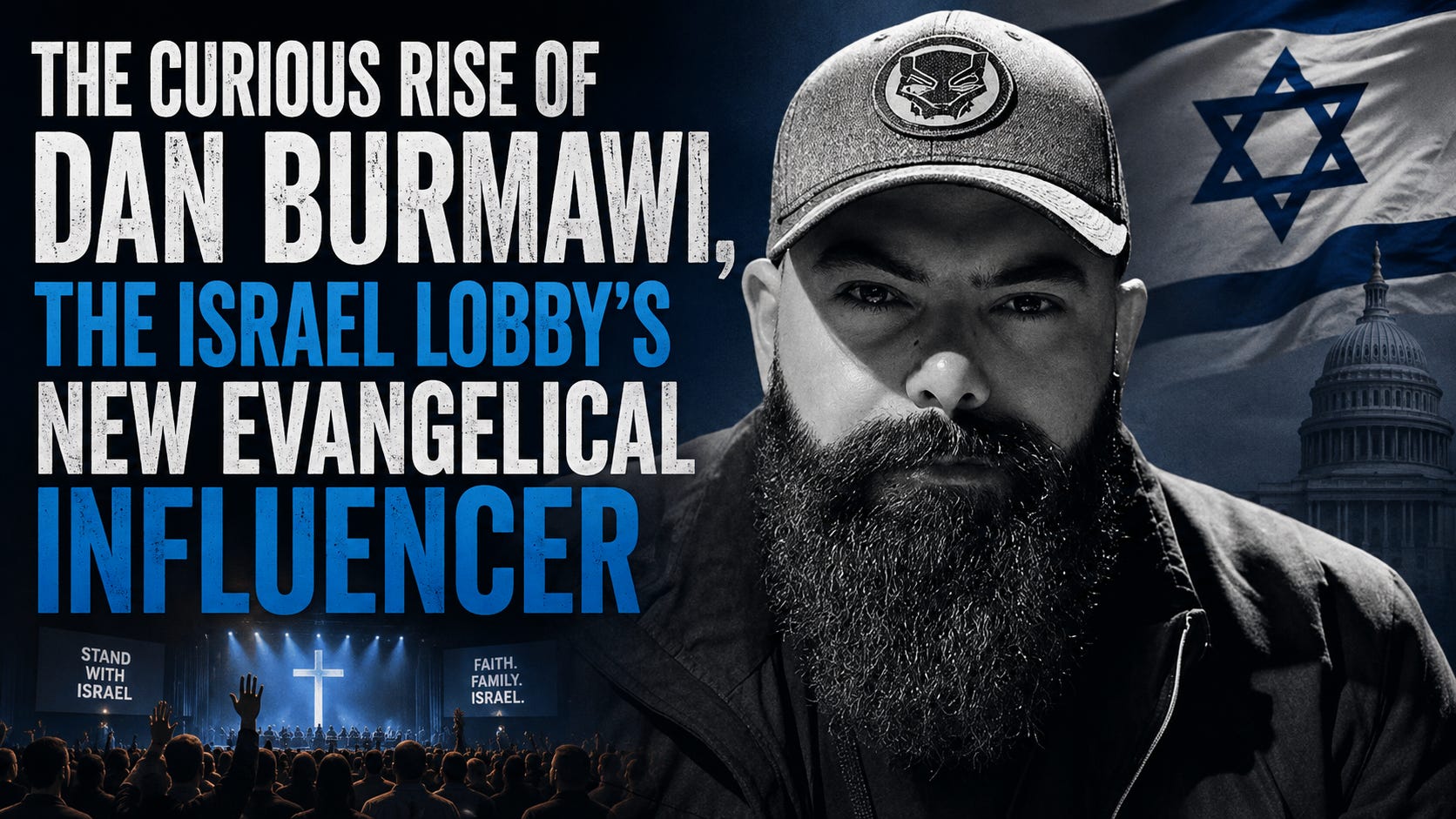
What happens when a theology that tells American Christians they must “become Jewish” collides with a foreign government spending millions to keep evangelicals politically loyal to Israel? Dan Burmawi’s recent article provides an unusually revealing case study. He tells Christians they have been grafted into “Israel’s covenantal family,” praises rabbis as models for Christian preaching, and argues that Christianity becomes corrupted when separated from its “Jewish identity.” On its own, that would be bad theology worth correcting. But placed inside a documented Israeli influence campaign specifically targeting American evangelicals, it becomes considerably more interesting. Every theological error in Burmawi’s article bends in exactly the same direction, toward making Christian faithfulness indistinguishable from identity with Israel.
Israel’s continued existence in the Middle East depends heavily upon American charity, and not merely the billions of dollars Washington pours into the IDF every year. The United States provides Israel with the diplomatic armor of its U.N. Security Council veto, replenishes its weapons, subsidizes its military, and when Israel’s wars threaten to outrun its capacity to cash the checks it writes, American military power waits behind it like a second big brother who doesn’t care who started it.
But the American public underwriting Israel’s outsized ambitions at regional hegemony has grown tired of it. After Gaza, Americans have spent years watching Israeli conduct that is incompatible with the Western and Christian values invoked to justify the alliance in the first place. We have watched Washington discover seemingly bottomless reserves of money, weapons, diplomatic capital, and political urgency for a wealthy foreign nation while telling Americans that our own borders, infrastructure, housing crisis, and collapsing dollar are problems too complicated to solve. Worse, we have watched American politicians speak about Israel with a reverence and obedience they rarely display toward American Citizens who elected them. We live under the reality that a U.S. Congressman is infinitely more likely to discuss West Bank settlement than housing problems in the U.S.
The thread holding Israel like a spider on a web over an Islamic Middle East is gripped by two hands. One belongs to the old NeoCon war machine, for which Israel is viewed like the goose that lays golden eggs, with every crisis being an existential threat requiring more arms that turn the global war economy. Every failed intervention becomes the justification for the next one: Iran, Syria, Lebanon, Yemen, Gaza, Iraq. For the defense industry and its Washington priesthood, a Middle East permanently five minutes from Armageddon is not a policy failure, but job security.
The other hand belongs to American evangelicalism. Millions of Christians have been taught for generations that underwriting the modern State of Israel is obedience to God. The Israeli government therefore received something no ordinary American ally could purchase: a vast grassroots constituency trained to support Israel, no matter their ungodly, genocidal behavior, or even their mistreatment of Christians. Genesis 12 became a foreign-aid authorization, but praise be to God, that firewall is beginning to crack. Only 59 percent of evangelicals still regard backing Israel as necessary or ethical. A generation ago, questioning unconditional support for Israel could get a conservative Christian branded a heretic, an antisemite, or both. Today, it still does, but fewer people believe it.
Israel cannot easily replace them. Access to Washington can be paid for by money from Washington, in a never-ending loop of lobbying power. But support lost among evangelicals because the stranglehold of Darbyism and Dispensational Zionism is weakening as Christians turn to their Bible and return to Covenant Theology cannot be caught up by another check. That takes generations of brainwashing inside the Israeli evangelical influence operation, and it’s dying thanks to increased Biblical literacy. This is why the fight over Christian Zionism is not merely another intramural theological squabble between prophecy nerds. Israel’s survival hangs in the balance. And Israel is fighting for its life.
THE INFLUENCE CAMPAIGN
We know how Israel’s influence campaign works, because Insight to Incite uncovered it. We’ve seen the FARA filings, highlighting the Israeli government influence campaign. Their goal is to infiltrate and manipulate American churches, Christian radio, and connect with evangelical influencers who will take payment for pushing “narrative messaging,” IE propaganda that looks like authentic Bible study, but is, in fact, state-sponsored manipulation material.
Israel’s Foreign Ministry funds this work. The initiative commonly called Project 545 directs public-diplomacy money toward Christian and evangelical audiences. It is government-funded persuasion aimed at a specific American constituency. Israel’s public diplomacy funds are massive and work similarly to Soviet “Active Measures” during the height of the Cold War. But Israel doesn’t spread out the propaganda like Russia had to do over half the globe. Its influence campaign is concentrated singularly on the United States, and most of that, on evangelicals specifically. Evangelical America is under a constant COVID-level propaganda campaign and largely doesn’t know it, becuase it’s designed to look organic. Nobody expects foreign messaging to be coming from their own pulpit or Sunday School literature.
Friends of Zion and its museum in Israel appear to be a Christian Ministry. It is, in fact, an Israeli-funded influence op. Christians United for Israel (CUFI) appears like an organic Christian movement, but it coordinates its messaging on behalf of the Israeli government. The Fellowship of Israel Related Ministries (FIRM) is another cog in the wheel. And only a tiny amount of Israeli lobbying is legally filtered through FARA. Most of the time, evangelicals have no idea that they’ve been subjected to Bible-twisting on behalf of a foreign nation. And thanks to the subversive nature of this influence op, American Christians have to stop and really consider how much of it is authentic theology and how much is curated and funded by the nation of Israel.

DANNY BURMAWI
Danny Burmawi was born in Jordan in 1988. He spent his early life there as a Muslim before converting to Christianity, a decision he claims cost him his standing in his family and homeland. Because Jordan doesn’t let its citizens change their religion on their documents and civil affairs are governed under Sharia, with prohibitions on conversion and sanctions on apostates - something I can affirm from my time in Amman - he left Jordan and lived for 14 or 15 years in Lebanon, depending upon which of his bios is right. What he did there for 15 years, specifically, is unknown.
Lebanon was a natural place for him to go. It was carved out under French mandate in 1920 to create a state with a Christian plurality, and its 1943 National Pact still reserves the presidency for a Maronite Christian. There is no official state religion in Lebanon, and Christians held a strong demographic majority through much of the twentieth century, and many Americans never knew or couldn’t imagine a Christian-majority nation in the Middle East, but it was fact, not fiction. Unfortunately, Israel has changed that. Decades of Palestinian refugees and well more than a million Syrians since 2011 have caused the Christian majority to dwindle to a minority, largely thanks to the destabilization of the Middle East being Israel’s chief foreign policy goal. Israel’s evacuation orders in Christian-held Lebanon have also drained its Christian population, and because they are reusing the Gaza strategy - order evacuation, then demolish whole neighborhoods and villages - it makes their return impossible.

If Burmawi has ever spoken sympathetically of Lebanon’s loss of its Christian majority at the hands of Israel’s foreign policy, I’ve not seen it, and couldn’t find it, because I looked. That’s the first in a long line of oddities when it comes to Burmawi and his story. One would think that compassion for Lebanon’s Christian population would be paramount, for a place and people who provided him Christian refuge from Islamic persecution. But from Burmadawi there appears to be only support for Israel’s actions in Lebanon, despite Christians being disproportionately killed and cleansed from their homeland.
Israel's actions in Lebanon have been tragic for Christian civilians, despite a campaign supposedly focused on “hunting Hezbollah.” Christian villages along the southern border, like Marjayoun, are inside Israeli evacuation zones and under direct fire, despite having no known connection to Hezbollah. When Christian residents of Marjayoun chose to stay in their indigenous homes, Israeli tanks pushed them into southern Lebanon and tore their homes to the ground. Now, roughly ten percent of Lebanese territory is under an active Israeli evacuation notice, many of them Christian areas, and they, too, are fleeing. Many will not return, and Lebanon’s Christian minority will again shrink, as it’s been doing because of Israel, for generations.
That Burmawi doesn’t defend Lebanese Christians is an understatement. I’ve found the opposite: a tone of beratement for their “support of Hezbollah” and refusal to make an “Israeli-like sovereign state” and revolt against the Lebanese government. For the record, Lebanese Christians do not routinely “support Hezbollah,” but they do fear the IDF more than Hezbollah, who has routinely protected them from ISIS.
Burmawi’s hot-takes are flat-out Israeli talking points, whether or not I can prove they were assigned to him by Israel. In fact, in July, Burmawi said on X that the Christians in Lebanon want Israel to annex them, repeating a claim of Netanyahu on Fox News the same day. I’d put a crying-laughter emoji if I didn’t mind sullying my beautiful Substack with Zoomer hieroglyphics. Humorously, his absurd claim came right after his assertion that Greater Israel is a “lie” and Israel has never wanted to expand past their current borders. So, to Burmawi, Israel doesn’t want to expand its borders, but also, they should annex Christian Lebanon.
Burmawi’s claim, and Netanyahu’s, about what Christians in Lebanon want is a lie. Christian villages in the Marjeyoun area denied the claim, stating they reaffirm their “loyalty to their national identity” and “attachment to their Lebanese flag.” The mayor of Rmeish, a Christian town, produced a joint statement from 15 different Christian villages rejecting their desire to be annexed to Israel, calling annexation “absolutely out of the question.” The mayor of Qlayaa, another Christian border village, said, “Quite the opposite. We’ve done everything they’ve requested of us so that they don’t have an excuse to enter. We don’t want the Israelis or Hezbollah. Let them kill each other and leave us out of it.”
Why is Burmawi repeating Netanyahu talking points, verbatim?
Burmawi’s X account reads like an Israeli operative trying to convince Lebanese Christians to rebel against the only nation in the Middle East that doesn’t reflexively persecute Christians, and to convince the rest of the world that the Lebanese Christians deserve whatever Israel has coming for them. Absolutely nothing Burmawi has said about Lebanon reads as compassion for the Christians who live there. It is, “revolt against your government, choose annexation to Israel, and do what the IDF tells you, or you deserve to die.”
So, color me skeptical about Badawi’s sudden appearance in the United States, a Master's Degree in theological studies that appeared soon after his arrival, and a background completely scrubbed from the Internet, or one that was never there.
Badawi alleges to have run several “NGOs in the Middle East,” but what those NGOs are, what they did, and whether or not “Middle East” means Israel, I can’t determine. It appears to have been scrubbed, if indeed it existed. There is almost nothing to prove he even existed back then, except for a single, solitary book peddled with his name on it from New Nation Ministries in 2019, a small evangelical outfit based in Beirut, and a brief mention in the blog of a missionary. There’s not a sermon clip, not an interview, not a testimony video, nothing. A man who claims to have spent fifteen years building organizations and leading initiatives across the Middle East left behind exactly two pieces of text and not a single frame of video before the year his American media career began.

He claims to have left Lebanon for Canada in 2022, stayed there just long enough to have a baby so that it would have Canadian Citizenship, and then came to the United States because, as he says, “The U.S. does not allow birth tourism.” After the birth, he came to the U.S. roughly 6 months later. It must have taken a pretty penny to make that sojourn, subsist without gainful employment, and then on to settle in the United States to immediately begin two years of school. The NGO business must be lucrative.
According to his bio material, his public activism “gained prominence” immediately following the October 7, 2023 Hamas attack on Israel, at which point he began publicly defending Israel and warning about Islamic expansionism. But that’s untrue. He did not gain prominence immediately following the October 7 attacks in 2023. He was still a ghost. He didn’t show up publicly until 2025, at which point he had a nonprofit, the Ideological Defense Institute, a bestselling book, and a rotating seat on the biggest stages in Christian Zionist media.
Out of nowhere, suddenly, his star rose in 2025, and he hit the Israel Lobby circuit like a freight train. Amir Tsarfati’s Behold Israel, First Fruits of Zion’s Messiah Podcast, the Middle East Forum, a Times of Israel byline, and a dozen more Israel or Israel Lobby podcasts, each and every one Israel-oriented. Then, exactly at the same time as his Israel Lobby podcast launch, a credential appeared in his biography for the first time: Master of Theological Studies. He eventually told me privately the name of that institution, and that he sped through his Master’s work from the moment he hit the ground in the United States. But he asked me not to share it, because it’s dangerous for people to know where he lives, on account of being a converted Muslim who’s outspoken against Islam. He’s more likely to be killed by a falling vending machine in the United States than by Islamic terror, but I’ve respected his request.
I’ve since not been able to independently verify with that institution if indeed he obtained the degree. If so, congratulations are in order for hustling through the coursework so quickly.
That is also why the years in Lebanon deserve more scrutiny, not less. Absolutely no paper trail? No digital footprint? And suddenly, in 2025, a fully formed media career, and a new career as full-time pro-Israel evangelical influencer? Coming out of absolutely nowhere, someone with a mysterious background has now arrived in the U.S. and is immediately catapulted into influencer status by exclusively Israel Lobby media? The man’s story makes Ergun Caner’s sound plausible by comparison.
THE JUDAIZING HERESY
Judaizing is not, first-and-foremost, a demand, like requiring someone else to snip their foreskin or give up pork. Heresies are the beliefs which undergird those underlying demands. The Judaizing Heresy is a theological malfunction manifest in different ways in different eras and at different places. Chiefly, it is the belief that by their ethnic lineage, Jews retain a special status, and Covenant blessings and promises obtainable without faith in Jesus.
To put it another way, the Judaizing heresy is the belief that God is indeed a respecter of persons and reserves for Jews a special favor undistributed to the Gentile believers. Demanding, for example, circumcision or dietary observance is a manifestation of the underlying heresy. At different times and different places, it takes different forms. But they all are caused by the underlying belief that by becoming Jewish, a Gentile can access a special status with God. And that’s the heresy.
The New Testament consistently denies that ethnic Jews retain covenant status apart from faith in Christ, and it treats any belief to the contrary as a gospel error, not mere stylistic disagreement. In Romans 2:28–29, Paul explains that a true Jew is not outward but inward, by the Spirit. In Romans 9:6–8, he clarifies that not all descended from Israel belong to Israel, and that the children of God are defined by promise, not flesh. Instead, the Bible teaches that those of faith are the sons of Abraham (Galatians 3:7), and all who belong to Christ are Abraham’s offspring and heirs (Galatians 3:29).
So the core error behind Judaizing is this: the belief that Jews retain covenant privilege by lineage apart from faith in Christ. Circumcision, dietary laws, and similar requirements are just outward expressions of that deeper doctrine. And the apostles oppose it because it contradicts the central claim of the gospel, that covenant blessing comes through Christ alone, to all who believe, without distinction.
Burmawi’s recent blog post, “To Be a Christian, You Must Become a Jew,” is one of the most overt, textbook examples of Judaizing that I’ve ever seen. It’s literally there in the title. And the article’s contents don’t improve it.
“TO BE A CHRISTIAN, YOU MUST BECOME A JEW”
Burmawi opens his article with his testimony as a convert from Islam and pivots into a sweeping argument about the order of salvation. He claims that God saved Israel from Egypt before giving the law at Sinai, proving that belonging to God was never conditioned on obedience, only on promise. From there he indicts the church for repeatedly “betraying its Jewish roots,” first through Marcion in the second century, then through centuries of man-made legalism that turned grace into a performance-based system, which he says is indistinguishable from Islam. His prescription is that Gentile Christians “must recover a Jewish frame for the gospel,” culminating in the title’s assertion, becoming a Jew to become a Christian. To be clear, he says that believers are not called to convert to Judaism, per se, but to become “Jewish Christians, people of the covenant,” grafted into what he calls “Israel’s covenantal family,” modeled on the preaching he hears from contemporary rabbis.
Referring to the Christian Old Testament as the “Hebrew Bible,” Brumawi writes…
There is something unique about the Hebrew Bible that distinguishes it from every other religious book in the world, and that is the order of salvation. Salvation took place before the demands of God were given. In every religion, the gods, religious systems, or philosophies require people to fulfill an enormous list of demands in order to have a chance of entering Paradise, avoiding punishment, being reborn into a better life, escaping the cycle of reincarnation, or achieving some other form of spiritual liberation. In the Bible, however, God saved Israel first. He brought them out of Egypt, and only after their liberation did he give them his law. Their salvation from Egypt was not contingent upon their obedience to the law.
Burmawi repeatedly claims that the Law did not exist prior to Sinai. That’s inaccurate. Paul explains this in Romans 5:13-14: despite the Moral Law not being yet written down, man was nonetheless held accountable for its violation, which is why men died, suffering under sin’s mortal consequences. Moral right and wrong have always existed, which is why God punished Cain for murder, despite it coming before “Thou Shalt Not Steal.” The subtle clue of the 4th Commandment, which says to “remember,” implies a working knowledge of God’s Commandments before God etched them on stone tablets with His finger. The Decalogue was not new to the Hebrews, as though they had never known not to steal, kill, murder, or blaspheme. It’s been etched on our hearts, which is why people in the God-forsaken Third World who have never heard of Moses are still “without excuse” according to Romans 1, despite never having seen God’s written Law on tablets of stone or in the Bible, either one.
Burmawi is right that Israel’s role in redemptive history did not evaporate the moment individual Israelites sinned. He is wrong to conclude from this that Jews retain covenant standing before God regardless of lacking faith. Paul closes this loophole in Romans 2, “For no one is a Jew who is merely one outwardly, nor is circumcision outward and physical. But a Jew is one inwardly, and circumcision is a matter of the heart, by the Spirit, not by the letter” (Romans 2:28-29).
Why does Burmawi make this claim about the Law at all? He says that he’s building the case that belonging to God doesn’t require obedience to the Law, so as to magnify a grace-based salvation. I believe he has ulterior motives: to argue for modern Jews remaining in the Covenant outside of faith, emphasizing their chosenness. In any event, he’s wrong.
Paul does not say “ethnic Israel keeps its covenant no matter what.” He says that ethnicity was never the Covenant criterion in the first place. Deuteronomy 31 predicts Israel’s coming apostasy, but Deuteronomy 30, one chapter earlier, frames Israel’s future restoration as conditioned on repentance and a circumcised heart, not as an unconditional guarantee:
“And the LORD your God will circumcise your heart and the heart of your offspring, so that you will love the LORD your God with all your heart and with all your soul, that you may live” (Deuteronomy 30:6), followed by “And you shall again obey the voice of the LORD and keep all his commandments that I command you today” (Deuteronomy 30:8), and again, “when you obey the voice of the LORD your God, to keep his commandments and his statutes that are written in this Book of the Law, when you turn to the LORD your God with all your heart and with all your soul” (Deuteronomy 30:10). The Covenant is never granted automatically to Israel regardless of its posture toward God.
Paul goes further still. He quotes Hosea, applying the phrase “I will call them my people who were not my people” to God’s inclusion of the Gentiles (Romans 9:25-26). If Paul is willing to say a people can move from “not my people” into “my people,” the reverse direction is also true of Israel for the same reason Hosea originally said it: Israel’s covenant unfaithfulness. The wilderness generation died in the desert and never entered the land, and Hebrews says why. “So we see that they were unable to enter because of unbelief” (Hebrews 3:19).
Burmawi says…
“Although the early church consisted mainly of Jews who believed in Christ, it was only a matter of time before Gentiles became the majority. Gentiles had little knowledge or understanding of God’s covenantal grace. In this sense, they were worse than the religious Jews whom Christ condemned.”
The Scripture does not say Gentiles were “worse.” Burmawi has this backward. Scripture consistently teaches that greater revelation produces greater culpability, not less. Hebrews 10:29 says, "How much worse punishment, do you think, will be deserved by the one who has trampled underfoot the Son of God, and has profaned the blood of the covenant by which he was sanctified, and has outraged the Spirit of grace?"
That is the exact opposite of Burmawi's claim. Those who possessed the covenant, witnessed the miracles, and heard Christ's own words firsthand and still rejected him bear the heavier judgment, not the lighter one. Jesus is speaking specifically of the Jews when He says in Luke 12, “And that servant who knew his master's will but did not get ready or act according to his will, will receive a severe beating. But the one who did not know, and did what deserved a beating, will receive a light beating. Everyone to whom much was given, of him much will be required, and from him to whom they entrusted much, they will demand the more."
Burmawi concludes the Gentiles were “worse” because their pagan beliefs were all law. Again, Scripture says the opposite of Burmawi. It was the Jews - time and again - for whom the Law was a stumbling block, never Gentiles. Paul says this explicitly in Romans 9:31-33. “Israel who pursued a law that would lead to righteousness did not succeed in reaching that law. Why? Because they did not pursue it by faith, but as if it were based on works. They have stumbled over the stumbling stone, as it is written, ‘Behold, I am laying in Zion a stone of stumbling, and a rock of offense; and whoever believes in him will not be put to shame.” (Romans 9:31-33). This is Paul’s own summary verdict on his kinsmen, and it is Israel, not the Gentiles, who tripped over the law by turning it into a system of works.
When Paul names the specific offense the gospel gave to each group, the law and its supposed guardians come out worse. “For Jews demand signs and Greeks seek wisdom, but we preach Christ crucified, a stumbling block to Jews and folly to Gentiles” (1 Corinthians 1:22-23). Even in the one place Gentiles are described stumbling at all, it is over folly, a failure of philosophy. Israel’s stumbling is described as a stumbling block, the same word Paul used for the very stone Israel tripped over in Romans 9, planted in the middle of the law they were trying to keep. Stumbling over the Law is fundamentally a Jewish problem.
Burmawi says…
On the other hand, after the destruction of the Temple, Jews had to adapt Judaism to a radically new reality. During this development, firmer boundaries were established between Jews who followed Jesus and Jews who did not. Therefore, Christianity was increasingly severed from its Jewish roots.
No, Jews did NOT have to “adapt” when the Temple fell. They had to repent of Judaism, the religion of the Pharisees. Burmawi says this of the Rabbinic religion as if it were a necessary consequence of the Temple’s destruction, without a hint of condemnation. And “adaptation” is an understatement. It was invention, not adaptation. When the Temple fell in AD 70, the sacrificial system Moses commanded fell with it. Suddenly, every single component of authentic Old Covenant worship was gone. No altar. No Levitical priesthood. No blood atonement. No Mosaic religion whatsoever. There was no means for the Mosaic religion to continue real observance.
Rabbinic Judaism did not “adapt” around this loss. It manufactured an entirely new religion with no basis in the Christian Old Testament at all. Prayer and study replaced sacrifice and atonement. A newly fabricated oral tradition was eventually codified into the Mishnah and Talmud, and a rabbinic authority structure was placed where priest and altar used to be. None of this exists anywhere in the Torah. It was built after the fact, to paper over the absence of everything present under the Old Covenant.
Burmawi’s “firmer boundaries” line is also an understatement. What actually happened was expulsion, not fence-building. The Birkat HaMinim, the curse against heretics inserted into the daily synagogue liturgy in the late first century, was written to identify and expel Jewish believers in Jesus from the synagogue, forcing a choice between reciting a curse on their own faith or leaving. That is not a boundary. That is an armed checkpoint, built for the explicit purpose of severing Christian Jews from the religious identity Burmawi says Christianity abandoned. They were forced out at spear-point.
The Text itself already told this story in advance. Jesus had already told the woman at the well that true worship would no longer be tied to any mountain or building (John 4:21). He called his own body the temple that would be destroyed and raised in three days (John 2:19-21). Hebrews, written before AD 70, already declared the first covenant obsolete and ready to vanish (Hebrews 8:13). The Temple’s fall was not a crisis Judaism had to improvise around. It was confirmation that Jesus demolished their religion with a Roman wrecking ball.
So reverse Burmawi’s sentence, and it becomes accurate. Christianity was not “severed from its Jewish roots.” Rabbinic Judaism was severed from its Christian roots, the ones you read about in the Christian Old Testament. To put another way, that’s not when Christians fled Judaism. That’s when Judaism divorced itself from the Christian history in the pages of the Mosaic Law.
He goes on to complain of Marcionism, revising the heretic Marcion as an antisemite: “He rejected the Old Testament and removed from the New Testament writings or passages that he believed were too Jewish.” It’s not like Marcion didn’t like Jews. It’s that he believed the Old Testament God was not the God of Christianity. It was heresy. But it has absolutely nothing to do with anti-Jewish discrimination or whatever kind of AIPAC version of history he’s blathering on about. Notice the constant conclusion: Old Testament = “Jewish.” That’s not how Christians think. Old Testament = Christian history.
He then writes…
Even though the church condemned Marcionism, Christianity was soon transformed into a religion based heavily upon obedience to religious rules. Religious Jews had taken the specific law given by God and used it as a tool to control the people. Religious Christians, who had been given the fluid law of love, possessed the additional privilege of being able to improvise and add almost anything they wished to the list of laws that supposedly determined whether someone belonged to God’s family.
Again, Murbawi’s confusion on the nature of the Moral Law comes out. Earlier, he had alleged that the Law did not exist before Sinai. And here, he refers to the Law of Love as “fluid,” and next contrasts it to Christians who don’t believe in dancing or drinking. The excesses of fundamentalist purity culture aside, the Law of Love he references is taken from Jesus in Matthew 22, in which He answers a question about the most important commandment with two: to love God and love your neighbor. But these are summaries of the Moral Law, not substitutes. With his two answers, Jesus summarized the Decalogue: the First Table is the commands that deal with our love for God, and the Second Table is the commands that deal with love for our neighbor. That’s how Christians for thousands of years have interpreted Jesus’ answer, because both commands are direct quotations from the Torah: Deuteronomy 6:5 and Leviticus 19:18. They were new in the sense of being new summaries. But they were both taken directly from the Bible.
Further, the Law of Love is not “fluid.” If it were, then there’s no reason that hairstyle, dancing, playing cards, non-modesty-related clothing choice, or alcohol consumption couldn’t be added if an argument can be made that it’s not loving. Loving God requires obeying the First Table, and loving our neighbor requires obeying the Second. Anything less is antinomianism, in which Christian behavior is regulated by our subjective impressions of what is and is not “loving” at any given time.
The difference between a Christian and a legalist is not the laws we follow. It’s our motivation for following them. The legalist follows God’s Laws and obeys His standards in order to be loved and chosen by God. The Christian follows God’s Laws and obeys His standards because he has been loved and chosen by God, not in order to be. The moment we ditch following God’s standards is the moment we’ve traded legalism for antinomianism.
He goes on, and it gets progressively worse…
Religious Jews before the time of Christ tied the law to God’s covenant and said, in effect, “The covenant is free. You belong to God’s family for free. But the law is what keeps you in.” The church did the same thing. It tied the gospel to performance: “You are granted salvation for free, but if you want to keep it, or prove that you really possess it, then you must perform.”
This Christianity is a non-Jewish Christianity. It is a Christianity that looks more like paganism, or more like whatever religion the Pharisees were selling during the time of Christ. It is not Jewish Christianity. It is not the Jewish covenant that Jesus came to globalize.
Track what the word “Jewish” is doing across his article. He alleges that “religious Jews” and Pharisees are the villains, the ones who “turned the law into a de facto condition for belonging to God,” the ones Christ condemned, the prototype of legalism itself. There, “Jewish” is at first the insult.
But then, he flips the word’s meaning. Legalistic church Christianity is now “non-Jewish Christianity,” a Christianity that “looks more like paganism, or more like whatever religion the Pharisees were selling.” Now, “Jewish” is suddenly the honorific, the standard of authentic grace-theology, and Pharisaism gets rebranded as pagan, something outside the category of “real” Jewish religion, rather than a historic, documented expression of it.
He can’t have both ways. The Pharisees were Jews. Not adjacent to Judaism, not an aberration imported from outside, but the dominant native Jewish religious party of the first century, operating entirely within Jewish categories, citing Torah, arguing halakha, tracing their authority back to Moses’ seat (Matthew 23:2). If Pharisaic legalism is “not Jewish Christianity” and “more like paganism,” then his own words previously, where Pharisaic legalism is his central illustration of what “religious Jews” did with the law, stops making sense. He used real, historical, ethnically and religiously Jewish legalism as his opening exhibit of the problem, and then later needs “Jewish” to mean something categorically opposed to that problem. It’s schizophrenic.
What he’s actually doing is using “Jewish” as a floating compliment, meaning whatever he currently wants to praise (covenantal grace, one moment, correct doctrine in another), and he is using “non-Jewish” as a floating insult for whatever he wants to condemn (legalism, performance religion, etc).
The word stopped referring to an actual ethnic or religious category and started functioning purely as a value judgment wearing an ethnic label. His entire argument’s controlling term, the very thing his title suggests, “become a real Jew,” has no stable referent. “Religious Jews,” on his own terms, are the Pharisees he condemns as legalists. “Real Jewish religion,” in his conclusion, is also somehow the cure for legalism. It’s nonsense. He needs the word to mean two incompatible things at once.
And as I said, it gets progressively worse…
Of course, I am not asking you to convert to Judaism. I am asking you to become Jewish Christians, people of the covenant. You belong to God not on the basis of what you achieve, but on the basis of what God freely gives. The concept of choosiness is what strikes me most when I listen to Jewish rabbis. They speak as Christian preachers should speak. They speak about God, their Father, who chose them not because of anything good in them, but because of his grace.
THE CONTRADICTIONS
Burmawi spends his entire article condemning religious Jews for turning covenant into a performance system, then closes by telling Christians to listen to religious Jews as the model of grace. He does not seem to notice he has just recommended the very group his own essay diagnosed as the problem.
What election are Rabbis actually preaching when they talk about being chosen “not because of anything good in them, but because of grace”? It’s not union with Christ. It’s not the New Covenant Jeremiah promised, in which God said he would write the law on the heart and remember sin no more (Jeremiah 31:31-34), the very covenant Hebrews says has already made the first one obsolete (Hebrews 8:13). The rabbis Burmawi is listening to preach Israel’s ethnic, national election as an end in itself, sustained by Torah observance, apart from and in rejection of the Messiah that the Old Testament pointed toward. That is grace-flavored language, but wrapped around the works-righteousness he’s been condemning.
The Rabbis are preaching ethnic salvation, a grace given to Jews irrespective of faith or obedience. That’s toxic. It’s Satanic doctrine. It sends their souls to hell. It’s not commendable. And nowhere does Burmawi suggest that they are lost in their trespasses and sins. He seems to suggest the Rabbis are right.
Burmawi writes, “They speak about God, their Father.” Whose Father, according to whom? Jesus said this to the most devout, Torah-observant, covenant-language-fluent religious leaders of his own day: “You are of your father the devil, and your will is to do your father’s desires” (John 8:44). That is not a verse Burmawi can wave off. It is Christ’s own verdict on Torah-zealous men using this kind of “covenant-family” language while rejecting Him. Burmawi hears rabbis calling God their Father and takes it as evidence of true relationship with God. Jesus heard the same claim from the same people and called their paternity a lie.
He wants Christians to imitate Rabbis who will, without a doubt, split hell open if they die without Christ. Then he says…
Dear Christians, if you are in Christ, then God has grafted you into Israel’s covenantal family.
No. No, no, no, no. No.
Dear Christians, if you are in Christ, God has not grafted you into the Jews' covenantal family, as though unbelieving Jews possess God's covenant and graciously permit Gentile Christians to occupy the guest room. God has grafted you into His covenant people. The covenant belongs to God, not to an ethnicity. Christ is not the Gentile entrance ticket into somebody else's family. Christ is the heir in whom the family itself is constituted. The tree is the church, comprised of ethnic Jews and Gentiles alike, but every last one, a Christian.
Burmawi suggests that ethnic Israel is the owner of the covenant and Gentiles are the beneficiaries let in by extension. Scripture never grants Israel that ownership. The covenant belonged to God from the start, made by God, sworn by God alone, and fulfilled in Christ alone. Israel was never the source or the guarantor of it. Israel was a steward and a vehicle, chosen to carry the promise forward through history, not the party holding the deed with the authority to graft anyone into anything. Jews are not “letting us in” to their house. God is letting us in to His.
This is also why unbelieving Jews can be, and are, described as cut off. “They were broken off because of their unbelief” (Romans 11:20). If the covenant were Israel’s family possession in the way Burmawi implies, ethnic Israel could not be cut out of it for unbelief, since a family doesn’t disown its own blood for failing to believe a claim about itself. But Paul says exactly that happens, which means membership was never a matter of belonging to “Israel’s family.” It was always a matter of belonging to the promise, which is Christ’s. Calling it “Israel’s covenantal family” gets the structure backward. It was God’s covenant, made with Abraham, fulfilled in Christ, carried through Israel’s history, and entered by faith, by Jew and Gentile on the same terms, into Christ.
According to Romans 11, once unbelieving Jews “do not persist in unbelief,” they are joining the Christian family. We do not join the Jewish one. Heck no.
And finally, this abomination…
Without the Hebrew Scriptures, we cannot understand God, Christ, redemption, the nature of the law, righteousness, justification, or imputation. Christianity becomes a pagan religion.
It’s the very opposite, and he’s got it backward. If you could understand the Old Testament without Jesus, Jews would be able to comprehend it. Clearly, that isn’t the case.
While the Old Testament is a divine gift to Christians to most fully comprehend the excellencies of the gospel, chronologically, the truths of the New Testament must FIRST be understood to seek the face of God. If you start reading the Old, without first knowing the New, you’ll understand not a single word. It’s like reading a coded telegram without the cipher key. Every word is legible, but none of it is intelligible
The Bible says, “But their minds were hardened. For to this day, when they read the old covenant, that same veil remains unlifted, because only through Christ is it taken away” (2 Corinthians 3:14). And then, speaking of the Jews it says, “Yes, to this day whenever Moses is read a veil lies over their hearts. But when one turns to the Lord, the veil is removed.”
Understand Jesus, and you’ll understand Moses. Without Jesus, you *cannot* understand Moses. God designed redemptive history and the advance of the gospel throughout the world on that precept - the New Testament must come first - and you can see that in the Book of Acts.
For example, Paul does not open at the Areopagus with Moses. He opens with an altar to an unknown god and a line stolen from a pagan poet, because the men standing in front of him have never read a word of Torah and never will. He tells them God overlooked the times of ignorance, then commands all people everywhere to repent, because a day is fixed on which the world will be judged in righteousness by a man he raised from the dead (Acts 17:30-31).
There was no Sinai. No Passover. No genealogy of promise stretching back through Abraham. He gave them no exhaustive explanation of Israelite history. No citing of Noah or Abraham or Moses or Adam. No Jonah and the Whale, David and Goliath, Noah and the Ark, Balaam and the Donkey, Elijah and Jezebel. He gave them just Christ, crucified and risen, dropped into the middle of a pagan philosophical marketplace with no Hebrew scaffolding underneath it. He didn’t draw on the Hebrew prophets. He drew on their own, because it would do as a frame of reference.
You see, that is what the Old Testament is for us. The Old Testament is our frame of reference. But the New Testament IS the reference. It is the very thing the Old Testament frames. It is the picture inside it.
So in Acts 17, could they be saved without the Old Testament? Of course; Dionysius the Areopagite believes, and Damaris believes, and others besides them (Acts 17:34). The gospel did not need the Hebrew Scriptures to reach Athens. It needed a crucified and resurrected Savior, not a lecture on Deuteronomic or Levitical Law. The New Testament does not frame the Old. The Old frames the New. The New is the central story of redemption. It’s the main show. The Old Testament is the spotlight. The New Testament is what’s IN the spotlight, being revealed.
Obviously, none of this undermines the need for the Old Testament for a full, thorough comprehension of God’s historic plan of redemption. Explaining the concept of sacrifice requires, at some point, a tour through the Old Covenant as designed by God. Understanding Jesus of Nazareth will eventually require understanding the Pillar of Cloud by day and Pillar of Fire by night, the burning bush, Melchizedek, and every place Jesus made his pre-incarnate appearance known or wherever else you can see Him in the Text.
That aside, a man can become fully born again, made regenerate, and justified by faith in Christ without reading or hearing a single word of the Old Testament. But no one can cross from death to life without the New. Both important. Both essential for their own purposes. But in a “chicken or the egg” situation, the New Testament must always be brought first. That’s why you don’t tell a man to begin reading in Leviticus. You tell him to begin reading in the Gospel of John.
Nonetheless, the New Testament is the means by which the Old Testament is properly understood. The New Testament illumines the Old and dispels its shadows. It is the key that unlocks the oracles. It is the light thrown backward across every page that Moses or the prophets wrote. It is the lamp Malachi never got to hold.
Christ is the Rosetta Stone of the prophets. He is the one who lifts its veil and gives meaning to that which, without Him, means nothing at all. And this is why unbelieving Jews not only don’t understand Jesus, but also - without Jesus - they don’t understand Moses. This is why there’s absolutely no one on this earth who understands the Old Testament less than a Rabbi. You’d more quickly ascertain its real meaning from a secular religious studies professor at the university. They cannot begin to decipher the oracles without Jesus as its key. It’s gibberish to them. It’s gobbledegook. Without Christ at its center, they instead only see themselves. And that takes it from being a beautiful Book to a hideously ugly one.
In Luke 24:27, Jesus is teaching the disciples, and it says, “And beginning with Moses and all the Prophets, he interpreted to them in all the Scriptures the things concerning himself.” Without Jesus, no proper interpretation is possible. Jesus - not Moses - gives an introduction to the eternal God of Scripture. He is the Author and Finisher of Faith. He is the mediator of the Covenant. He is the High Priest, that without Him, no acquaintance with the Almighty can be made.
An unbelieving Jew reading the Old Testament is reading someone else’s mail, addressed to another, sealed shut, written in a language they can’t possibly understand because it’s not in their tongue. Jesus is the only One who changes that.
Without the Old Testament, Christianity does not become “pagan.” I can demonstrate that, as the Gospel spread throughout the pagan world among people with next to no grasp of the Old Testament, it saved them from paganism. Without the Old Testament, Christianity cannot be properly understood in its fullness. An explanation of why God did what He did cannot be fully given; but what God did through His Son - to pay the penalty for sins, dying on the Cross, and raising again - absolutely can be trusted and believed to make one born again.
WHY THIS IS PROPAGANDA, NOT JUST BAD THEOLOGY
Back to our friend who parachuted into American evangelicalism from the Middle East in 2025 with a non-descript past and sketchy, vague background and popped up in the Israel Lobby ecosystem. Perhaps you’re thinking this is just run-of-the-mill bad theology. Maybe it’s just a person who doesn’t have their theology sorted out yet.
Look at what his language accomplishes. Christians are not grafted into God’s covenant people. They are grafted into “Israel’s covenantal family.” Christianity becomes authentic to the degree that it becomes “Jewish.” Rabbis become models Christians should imitate. The Jewish relationship to God becomes the template through which Christians are taught to understand their own election. By the end of the argument, Israel is no longer merely part of redemptive history. Israel owns the house, and Christians have been graciously given a key.
Now move that theology from the Sunday School room to Washington. If Israel is merely another foreign state, Christians are free to judge it like any other foreign state. Is this alliance good for America? Is this war just? Should we pay for it? Should American soldiers defend it? Should Israel receive billions while persecuting Palestinian Christians, bombing Lebanon, or doing things we would condemn if another nation did them? Those become ordinary moral and political questions requiring ordinary moral and political answers.
But make modern Israel the earthly embodiment of “Israel’s covenantal family,” and those questions become spiritually dangerous. Opposition to Israeli policy can be recast as opposition to Israel. Opposition to Israel becomes opposition to God’s covenant people. And opposition to God’s covenant people becomes rebellion against God.
That is an extraordinarily useful theological chain for a foreign government dependent upon evangelical political support. And it targets the constituency Israel’s influence apparatus is trying to preserve.
As I explained above, Israeli-funded public-diplomacy efforts target American evangelicals because evangelical support provides political protection that increasingly does not exist elsewhere in the electorate. Burmawi’s theology produces the necessary political instinct such a campaign needs: Israel is not a foreign country Christians may evaluate. Israel is family Christians are religiously obligated to defend.
Call it God’s covenant, and Israel stands underneath God’s judgment like every other nation and every other sinner. Call it “Israel’s covenantal family,” and suddenly Christians stand underneath Israel’s judgment, indebted to a people supposedly holding the covenant into which we were fortunate enough to be admitted.
Bad theology can be accidental; it happens. But bad theology that consistently produces the exact political behavior a foreign influence campaign is spending money to cultivate deserves considerably more scrutiny.
Because at some point, theology that reliably turns American Christians into unconditional political patrons of another state stops functioning merely as theology. Instead, it functions as propaganda.
If you appreciate my work, please grab a premium subscription to access exclusive content, extra material, Zoom opportunities, and more. Act now and get a 20% discount. If you don’t do subscriptions, consider a one-time gift of your choosing by clicking here.


