


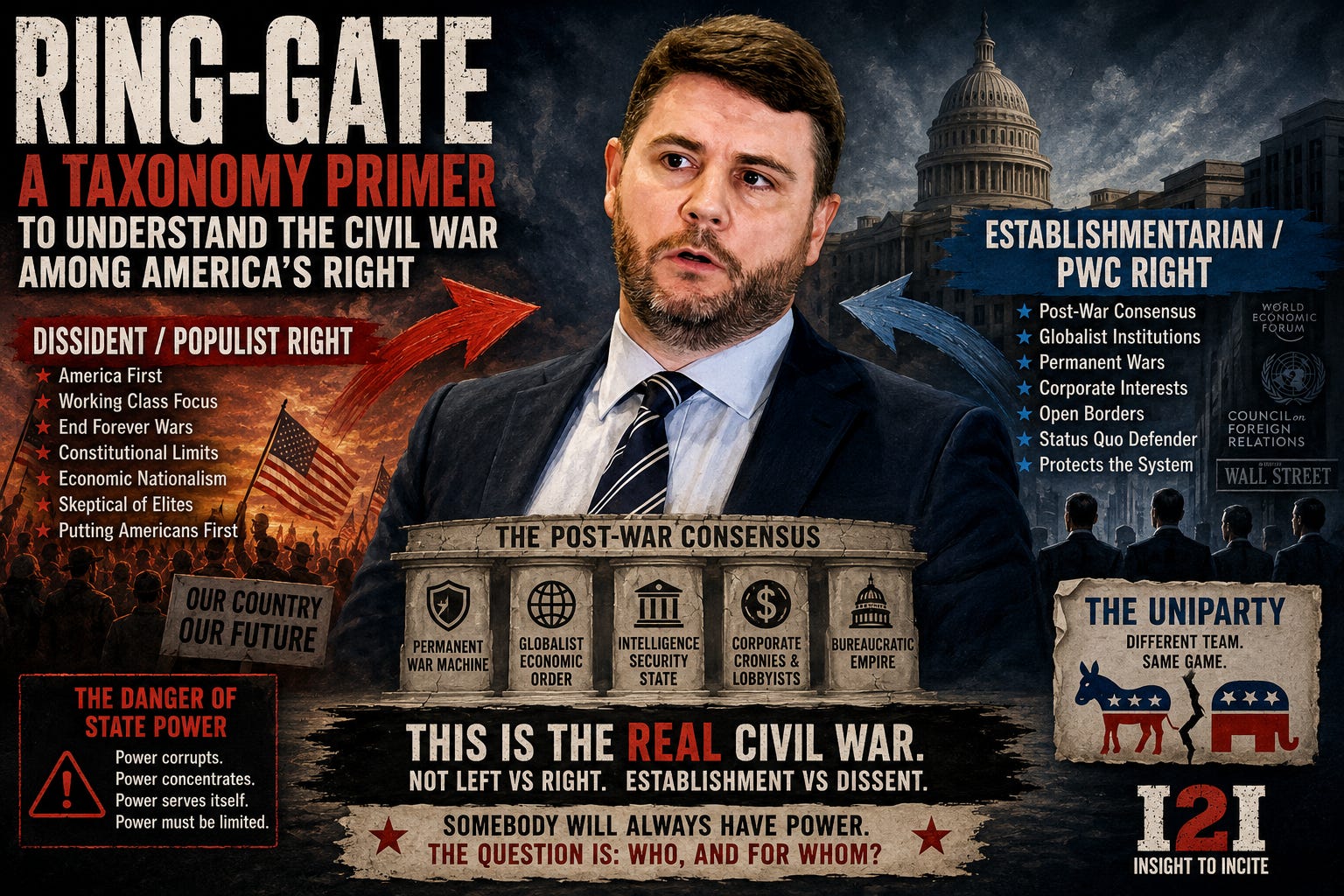
Good framing of an issue matters for people’s understanding, helping folks wrap their heads around what’s happening and why, who the sides are, and where they should stand. I’m going to lay out for you the terms that are often used in today’s civil war on the right, explain their real meaning, help to demarcate the lines of this battle and its different sides, and show you why framing matters.
James Lindsay thinks he has discovered the great temptation of the “dissident” Right, and naturally, he explained it with a meme. Maybe you saw it on X last weekend. Boromir, from The Lord of the Rings: The Fellowship of the Ring, stares longingly at the One Ring in his hand. Across Boromir’s forehead, Lindsay stamped “WOKE RIGHT.” Across the Ring itself he stamped “STATE POWER.” The message isn’t subtle: the people Lindsay has spent the last several years branding the “Woke Right” are being seduced by political power. They have convinced themselves that they can seize the machinery of the state, wield it against their enemies, and somehow remain uncorrupted by it.
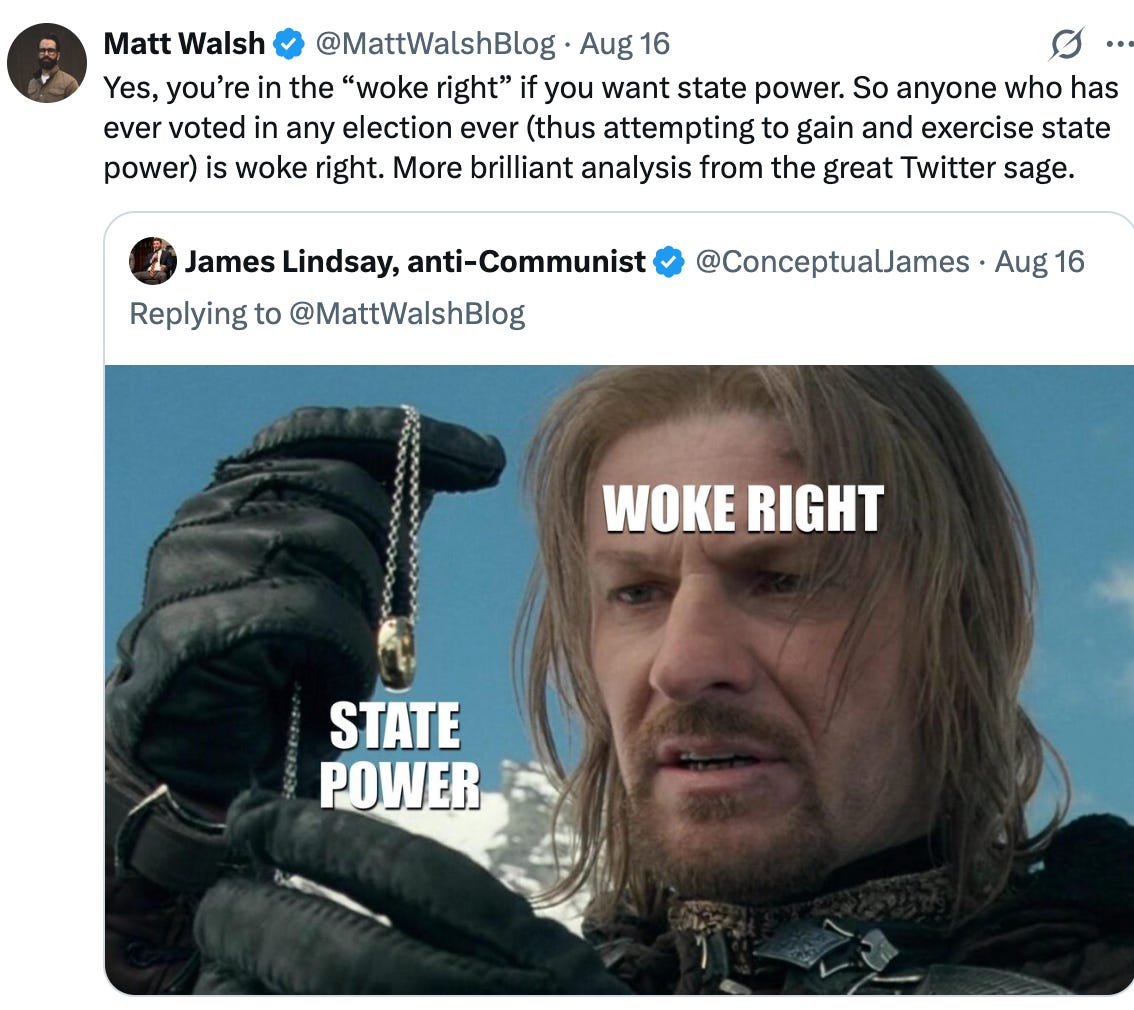
A legitimate warning is buried inside the meme, underneath layers of Establishmentarian: power is dangerous. His message is that conservatives who spent years watching the Left weaponize the legal system, government bureaucracy, the censorship regime, intelligence agencies, and other institutions should not conclude that the answer is to capture those weapons and point them in the opposite direction. If the Right’s answer to every abuse of power is going to become, “Wait until we get our turn,” then Boromir is not an altogether unfair comparison.
Unless we want to actually win. But if we don’t mind losing, we should definitely take that high road.
Matt Walsh thankfully noticed the rather large problem with Lindsay’s formulation. If merely wanting state power is what makes somebody “Woke Right,” then everybody who has ever participated in politics is guilty. Elections exist to determine who exercises political authority. A man voting for a sheriff wants someone to possess police power. A libertarian electing a congressman to abolish an agency is seeking political power to abolish it. A pro-life voter wants legislators and governors with sufficient authority to prohibit something he believes is evil. Politics without the acquisition and exercise of political power is not politics. It is a book club.
I added my own two cents because I think Walsh’s objection, while obviously correct, stops one step short of the real issue. I tweeted, “They’re not against government power. They’re against YOU having government power.” Those currently enjoying access to power are terrified that government might someday be redirected toward the interests of the people who actually elect it. The supposed sin is not merely that someone might wield political authority. Somebody already does. The terror begins when the wrong people start asking why it cannot be them.
Then Lindsay, almost as if determined to illustrate the point for me, made the subtext text. Complaining about Walsh and the people to whom Walsh supposedly “panders,” Lindsay wrote, “I shudder to think of people he panders to being in power.” And just like that, he said the quiet part out loud. Suddenly Boromir’s Ring looks different. Lindsay’s anxiety is no longer an abstraction about whether political power should exist. It is about which people might possess it. That was his trepidation all along.
Somebody is going to possess state power. There will be a Justice Department tomorrow morning whether conservatives feel morally pure about government power or not. Somebody will control the federal agencies. Somebody will write the regulations, collect the taxes, spend the trillions, negotiate the treaties, enforce or refuse to enforce the border, determine trade policy, regulate banks, prosecute crimes, impose sanctions, command the military, and decide which distant patch of dirt is suddenly important enough for an American kid to die on. The American state will not evaporate because conservatives have been trained to feel vaguely dirty about wanting control of it.
More importantly, the people lecturing you about the corrupting temptation of political power did not discover this concern in an anarchist commune. They live inside a political system already saturated with power. Our foreign-policy establishment has power. Our intelligence apparatus has power. Global finance exercises enormous influence over public policy. Defense contractors live on government appropriations. Multinational corporations employ armies of lobbyists to shape legislation and regulation. Foreign governments and their lobbies compete for influence over Washington. Permanent bureaucracies survive election after election while presidents come and go. None of this resembles a pristine free society suddenly endangered because a working man in Ohio wants his government to care about the price of burritos or whether his factory closes.
The fight on the American Right is not that hard to understand. We have been told that the great divide is between responsible conservatives and a dangerous new collection of populists, nationalists, economic heretics, “Woke Right” radicals, “Woke Reich” extremists, isolationists, conspiracy theorists, and crypto-Communists. But those labels obscure the more important division underneath them. Increasingly, the fight is between people who regard the prevailing institutional order as fundamentally legitimate and worth preserving, and people who have begun asking why that order seems remarkably good at preserving itself while the country beneath it gets poorer, weaker, more indebted, less sovereign, and increasingly difficult for ordinary Americans to live in.
There is a name for the first group that is considerably more useful than “conservative.” They are Establishmentarians. And to understand why they are suddenly so frightened of dissidents on their own Right, we have to understand what establishment they are actually trying to conserve.
THE ESTABLISHMENT AND THE POST-WAR CONSENSUS
Before we go any further, we need a word for the people Lindsay is actually defending. “Conservative” will not do. Neither will Republican, libertarian, neoconservative, globalist, Zionist, banker, bureaucrat, or corporate executive, because those describe different people occupying different pieces of a much larger machine. The word I prefer is Establishmentarian. An Establishmentarian is someone whose overriding political instinct is the preservation of the prevailing institutional order and the distribution of power that comes with it.

This does not require a secret clubhouse where Ben Shapiro, Jamie Dimon, a CIA director, an AIPAC lobbyist, a Democratic senator, and the CEO of Lockheed Martin gather every Thursday to receive their instructions from Satan. The Establishment is more durable than a conspiracy because it does not require one. Institutions develop interests. People acquire careers, fortunes, prestige, access, contracts, audiences, bureaucratic kingdoms, and political power inside those institutions. They naturally become reluctant to dismantle the machinery that produced them. The people occupying different parts of the machine can despise each other, vote differently, and disagree bitterly about abortion, guns, taxes, homosexuality, and elections while still agreeing that nobody should take a wrecking ball to the building they all inhabit.
That building was constructed largely after World War II. The United States emerged from the war possessing extraordinary economic and military power, and American leaders deliberately built a new international order around it. Bretton Woods placed the dollar at the center of a new monetary order and produced institutions like the International Monetary Fund and World Bank. The United Nations followed. NATO followed. The United States abandoned its old habit of raising enormous military capacity for war and substantially dismantling it afterward. In its place came a permanent national-security establishment, permanent overseas commitments, permanent intelligence institutions, and a permanent armaments industry.
Warnings from our Founders about permanent alliances be damned. We have a world to run.
Dwight Eisenhower watched the thing grow and warned us about it on his way out the door. This was no hippie burning his draft card. Eisenhower had commanded the Allied invasion of Europe and served eight years as a Republican president. Yet by 1961, he warned that America had acquired a permanent arms industry of unprecedented size, joined to an immense military establishment whose economic and political influence reached into every level of government. His name for it became famous: the military-industrial complex. More important than the phrase was his warning about what such a system could eventually produce, a “disastrous rise of misplaced power.”
The machine did not remain frozen in 1961 because the Cold War expanded America’s worldwide security commitments. The postwar financial system evolved. Global trade expanded. Capital became increasingly international. Capital became increasingly fake. American corporations became multinational corporations, supply chains stretched across oceans, factories moved abroad, and Wall Street acquired enormous influence over an economy increasingly measured by the accumulation of financial assets rather than the health of the towns where Americans actually lived. Downtowns died, but Wall Street soared. Families struggled, while the news told them how well the economy was doing based on the Dow-Jones. When the Soviet Union finally collapsed, the system did not pack its bags, declare victory, and go home. It expanded.
For example, NATO was established to defend against the Soviet Union. When the Soviet Union collapsed, we didn’t shut NATO down. We expanded it, despite no legitimate reason existing. When Russia asked to join NATO, we told them no. We can’t afford to win over enemies. We can’t afford to be without them.
Around this structure grew an entire ecosystem of permanent government bureaucracies, intelligence agencies, defense contractors, banks, multinational corporations, lobbying firms, think tanks, universities, NGOs, media organizations, technology companies, international institutions, and foreign interests seeking influence over Washington. They frequently compete with one another, and their interests sometimes collide, but they also overlap, exchange personnel, depend upon one another, and share an obvious interest in preventing the entire global arrangement from being turned upside down by several million angry people who suddenly notice they’re being exploited to maintain a world that is not improving.
That is what I mean by the Post-War Consensus, or PWC. It is not a claim that every policy since V-J Day was secretly written by a cabal in George Soros’ mountain lair. It is the broad institutional settlement that grew out of American global leadership after World War II and accumulated additional layers over the following eighty years. Presidents changed. Parties traded control of Congress. Wars started and ended. The Soviet Union itself disappeared. Yet the basic assumption that America should manage an enormous international political, military, and economic world order survived them all.
And this is where UniParty needs to be understood. It does not mean Republicans and Democrats are identical. They aren’t. It means that for decades the acceptable leadership of both parties largely operated within certain common boundaries concerning the basic structures of American power. Administrations changed, but the machinery remained. One party might turn one dial clockwise, and the other turn another counterclockwise, but both parties kept feeding it.
Neoconservatives are one cog in that machine, not the machine itself. Global finance is another. The military-industrial complex is another. The permanent bureaucracy is another. Foreign-policy think tanks, corporate lobbyists, multinational interests, intelligence agencies, media gatekeepers, and foreign governments attempting to influence American policy occupy still other positions. The mistake is looking at any one cog and assuming you’ve found the engine. It’s not just Israel. It’s not just the CIA. It’s not just the Federal Reserve. It’s not just the Council on Foreign Relations. The Establishment is the ecosystem produced by their intersection, and the Establishmentarian is the person whose politics reliably bend toward preserving it. It doesn’t matter if they’re a conservative Establishmentarian or a Liberal one; not really. It’s all the Establishment, one way or another.
Grasping that is crucial because an Establishmentarian can call himself a conservative while conserving remarkably little that previous generations of Americans would recognize as their inheritance. He can watch industries disappear, communities hollow out, debt explode, borders become abstractions, foreign commitments multiply, families become economically harder to make, and government become larger and more remote, yet somehow conclude that the greatest threat to America is the angry citizen asking why their burritos cost so much.
A conservative has to ask what is actually worth conserving, and sometimes that requires tearing down institutions that have outlived their purpose or turned against the people they were supposed to serve. The Establishmentarian has a much easier answer. Whatever else he is willing to sacrifice, there is one thing he can always be counted upon to conserve: the Establishment.
THE DISSIDENTS
Once you understand the Establishment this way, another word that gets thrown around suddenly makes a lot more sense: dissident. The word sounds sinister because it is supposed to. It conjures up radicals lurking outside respectable society, plotting against the institutions that keep civilization from collapsing. But a dissident is not necessarily a radical, and he is certainly not defined by how far Left or Right he happens to be. A dissident refuses to accept the boundaries of the approved political conversation.
The Establishment is perfectly capable of accommodating Democrats and Republicans because it has been doing so for generations. It can survive an argument about marginal tax rates. It can survive Republicans appointing conservative judges and Democrats appointing liberal ones. It can survive four years of one party running the executive branch followed by four years of the other. Those fights can be genuine, vicious, and consequential while still taking place inside a larger institutional framework that neither side seriously intends to dismantle.
The dissident becomes dangerous when he walks past those arguments and starts kicking the pillars. Why does the United States need troops scattered across the planet? Why are we obligated to fight this war? Why is this foreign alliance treated as permanent regardless of whether it continues serving American interests? Why did we ship productive industry overseas and then congratulate ourselves because imported televisions became cheaper? Why should capital be allowed to search the entire planet for cheaper labor while an American worker is told he must become more competitive or flexible or adapt to new careers? Why are multinational corporations treated as free-market actors when so many of them depend upon government contracts, subsidies, regulatory advantages, intellectual-property protections, favorable trade arrangements, and armies of lobbyists?
Those questions become even more dangerous when they leave Washington and arrive at the kitchen table. Why does a man with a decent job struggle to buy the kind of house his father bought on one income? Why are young couples delaying marriage and children because they cannot afford the necessities of family life? Why is consumer debt astronomical? Why does a trip through the grocery store feel like a mugging? Why can Wall Street celebrate while the town where you grew up loses its factory, its hardware store, its families, and eventually its future? At some point, people stop accepting charts showing that the economy is doing wonderfully and start trusting the far more persuasive evidence in their bank accounts.
This is why populism, rather than Left or Right, creates such panic within the Establishment. Bernie Sanders and Donald Trump do not share a political philosophy, but they do share something. Sanders attacked concentrated financial and corporate power from the socialist Left. Trump arrived from the nationalist Right attacking trade deals, mass immigration, the Iraq War, NATO burden-sharing, globalization, and the bipartisan foreign-policy class. Their diagnoses frequently differed, and their prescriptions differed even more, but both committed the same unforgivable offense: they told millions of Americans that the people running the system might be the problem.
That was the electricity behind Trump in 2016. Whatever else anyone thought about him, he walked onto a Republican debate stage and attacked propositions Republican voters had spent years being told were beyond discussion. He called the Iraq War a disaster. He attacked free-trade orthodoxy. He questioned whether America’s alliances were actually reciprocal. He treated the border as something a sovereign nation was entitled to control. Most importantly, he demonstrated that Republican voters had never consented to many of the sacred cows supposedly defining Republicanism. They had merely been told that accepting them was the price of admission.
Tucker Carlson eventually became dangerous for much the same reason. His great offense was wandering outside the fence. He began asking why Americans were expected to care more about another foreign adventure than their own collapsing communities, why young men could no longer afford families, why consumer debt was swallowing the middle class, why corporations that despised their customers deserved conservative loyalty, and why “the market” mysteriously became sacred whenever its outcomes benefited people who already possessed enormous economic power. The transgression was asking the questions in front of millions of people the Establishment didn’t want to answer.

The term dissident useful for this reason. It describes a relationship to power rather than a position on the traditional ideological ruler. A populist Leftist can be a dissident. A nationalist on the Right can be a dissident. A Christian who rejects the premises of secular liberalism can be a dissident. They can disagree with one another about almost everything and still provoke the same institutional immune response because each is willing to reopen questions the ruling consensus has declared closed.
The Establishment can tolerate an astonishing amount of Left versus Right warfare because Left and Right can fight indefinitely without threatening the machinery underneath them. What it cannot comfortably tolerate is outside versus inside. It cannot tolerate millions of people deciding that perhaps the experts who managed the country into $40 trillion of debt, endless foreign commitments, deindustrialization, unaffordable homes, collapsing trust, and national exhaustion should no longer enjoy an automatic presumption of competence.
And that is when the dissident discovers the price of asking forbidden questions. The Establishment does not always have to answer him. It has developed something much cheaper.
It can simply give him a label.
“THAT SOUNDS LIKE COMMUNISM”
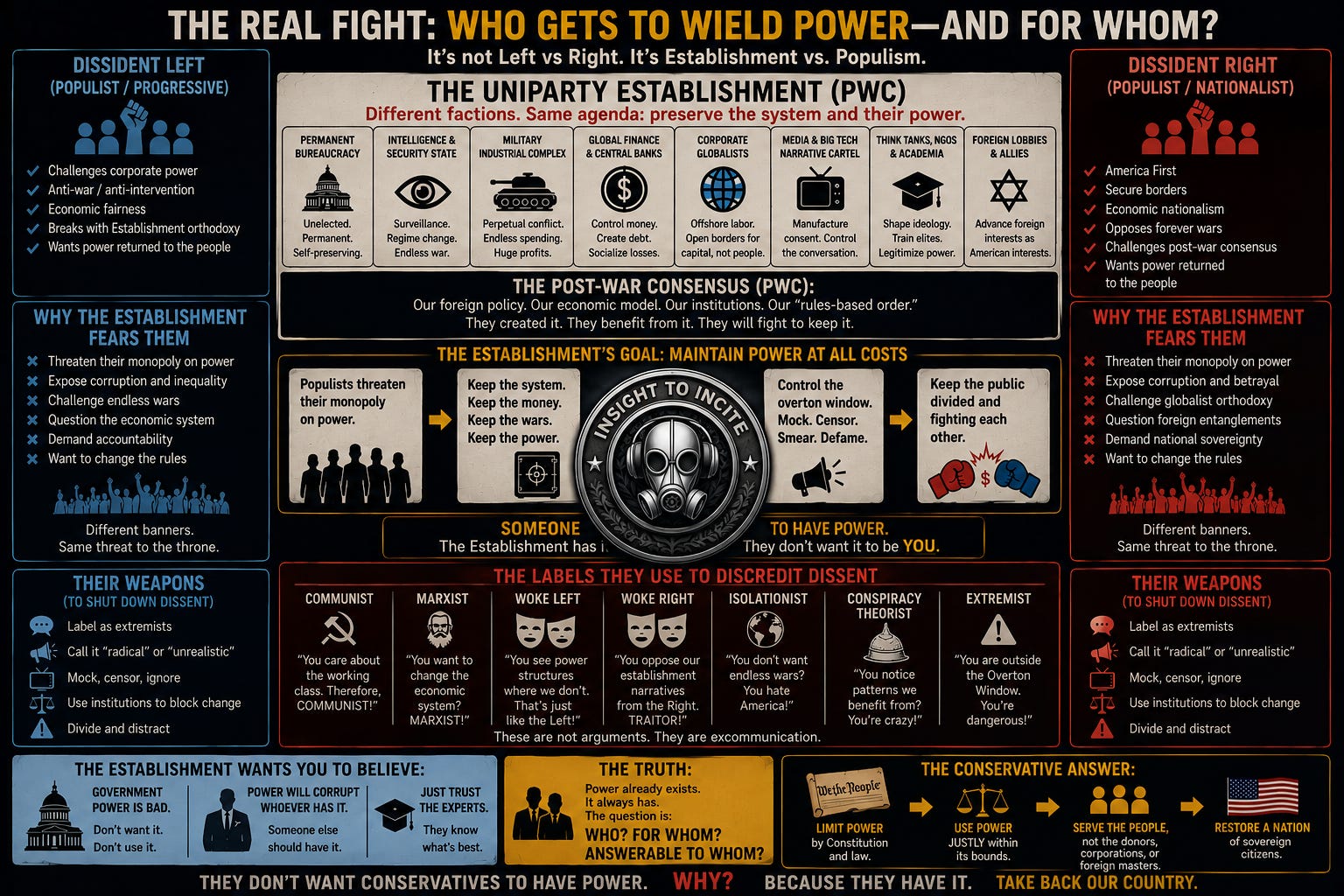
Once a political establishment has decided which questions people are allowed to ask, it does not need a terribly sophisticated method for dealing with people who ask the wrong ones. It needs labels. The labels change depending on the subject; instead of answering the dissident’s complaint, translate it into an ideology so poisonous that he is forced to defend himself rather than continue advocating for his interest.
The formula is simple. An American says his groceries are becoming unaffordable. Communist. He wonders whether importing millions of workers affects the bargaining power of American labor. Xenophobe. He questions another foreign intervention. Isolationist. He wonders whether a supposedly indispensable ally is actually behaving like one. Conspiracy theorist, antisemite, foreign propagandist. He suggests that multinational corporations should not possess an unlimited right to destroy American communities merely because doing so improves the quarterly return to shareholders. Marxist. He concludes that perhaps his own government should consciously prefer the interests of its own citizens.
Woke Right. Woke Reich. Scmoke Schmight. It’s all nonsense.
Sometimes these labels are perfectly accurate. Marxists exist. Racists exist. Conspiracy theorists exist, and Lord knows the Internet has manufactured enough of them. Antisemites don’t exist because that term is meaningless, but Jew-haters exist. The stunt occurs when the label is used not to describe an argument but to prevent anyone from having it. Once the guy complaining about grocery prices is busy proving he doesn't own a Che Guevara shirt, nobody has to explain why the grocery bill swallowed another hundred dollars.
Terribly intricate charts are obnoxious and hard to read, I know. But if you want to understand the big picture with these terms, zoom in on the image. Grasp it. Understand how it operates.
Burrito-Gate was an almost comically perfect demonstration. A $20 burrito became a stand-in for something much larger because ordinary Americans immediately understood the complaint. The point was never really the burrito. It was the experience of earning more dollars while discovering that those dollars purchase less life. Housing costs more. Insurance costs more. Food costs more. Vehicles cost more. Interest consumes more. Debt follows people around like a starving dog. The ordinary milestones of adulthood that previous generations regarded as mundane achievements increasingly require either extraordinary income or extraordinary debt.
And when people on the Right began saying that perhaps this deserves political attention, the ideological smoke alarms started screaming. Suddenly concern about affordability sounded suspiciously socialist. Caring whether workers can support families became economic illiteracy. Suggesting that government policy might have contributed to these conditions was treated as evidence that conservatives had abandoned capitalism. Dan Crenshaw, who invented the term “Woke Right” (which James Lindsay got from him), even framed concern about grocery prices as communism. The rhetorical purpose is obvious: move the argument away from whether Americans are being economically crushed and toward whether the person noticing it has committed ideological heresy.
Ben Shapiro’s response to the same broad economic frustration has repeatedly carried another Establishmentarian assumption: people must adapt themselves to the economy rather than asking whether the economy should be arranged to serve them. If you cannot afford to remain where generations of your family lived, move. If the local economy no longer supports you, acquire different skills. If your expectations exceed what the market presently provides, adjust your expectations. There is always some individual decision available, and therefore the system itself never has to enter the defendant’s box. When that fails, accuse the person of being entitled, selfish, spoiled, or ungrateful for living in the best country on Earth.
Tucker Carlson enrages them because he keeps dragging the system into the courtroom. What happened to the American working man? Why are people drowning in consumer debt? Why are families harder to form? Why did productive towns become wastelands while financial assets soared? Why should a conservative feel some sacred obligation to defend a corporation that will replace ten thousand American workers tomorrow morning if an algorithm can increase its margins by three percent? These questions violate the strange economic piety that took hold of the American Right, in which whatever outcome emerges from the existing economic order is presumed to be capitalism, and therefore questioning the outcome becomes an attack on capitalism itself.
That is nonsense. Capitalism is not God. Neither is GDP, the Dow Jones Industrial Average, quarterly earnings, shareholder value, or the sacred right of a multinational corporation to scour the earth for the cheapest human being capable of performing a task. We defend markets because private property, competition, entrepreneurship, voluntary exchange, and economic liberty have proved extraordinarily effective at producing prosperity and preserving human freedom. Capitalism is a means to human flourishing. Human beings are not raw material to be fed into capitalism so that economists can admire the output.
If you appreciate my work, please grab a premium subscription to access exclusive content. I2I has one of the highest rates of continued subscriptions on Substack, because subscribers don’t regret it. They love it and know they’re getting their money’s worth.


