


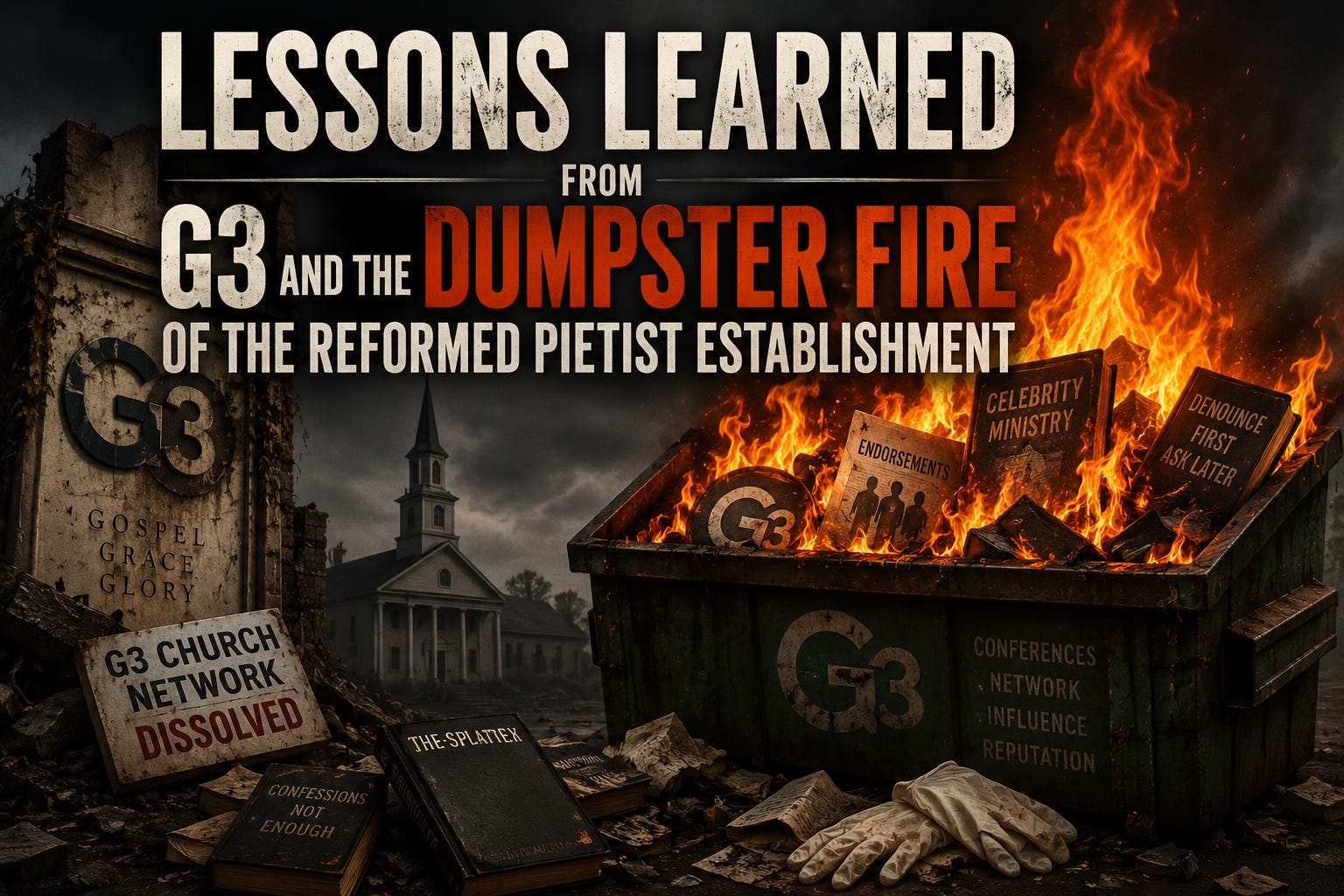
G3 is dead.
Or at least, the part of G3 that was supposed to survive conferences, personalities, and scandals is dead. And that’s really sad. Earlier this week, G3 announced that it was dissolving the G3 Church Network “effective immediately,” pulling the plug on more than a hundred churches organized into what was supposed to be a permanent fellowship of Reformed Baptist congregations. In the end, it fell as fast as Mars Hill. But unlike Acts 29, it did not survive the failure of its more notable leaders.
That is quite a crater. It’s embarrassing. Because these are the guys who are serious™ about doctrine. They’ve got it all figured out. But apparently, they don’t.
I’m not rubbing it in. That’s the first thing you’ve got to understand, and if you think this is a victory lap, you’re wrong. I’ve got no beef with G3. I’ve never had a feud with anyone involved in its leadership. And other than having once been temporarily kicked out of a G3 conference because an angry lesbian told them to, I’ve never had an axe to grind.
Okay, okay. That’s not exactly accurate. I complained regularly over the years of their speaking roster mocking me for my polemical warnings (you know, becuase I’m a crazy-eyed, paranoid radical who’s gone and jumped another shark) only for a year to pass, and then G3’s stage to be crowded with speakers freshly warning the world of a new and pressing danger, which is whatever they had mocked me for saying twelve months prior. Always being the bad guy for being first to reach a conclusion did get old. But it’s never been a blood feud. So please consider what I’m about to write as sincere.
What has befallen G3 is sad. I’m not happy about it. And I want it to stop happening.
The temptation, especially for those of us who spent years on the receiving end of G3’s finger-wagging, is to stand at the rim and admire the smoke. Steven Lawson fell. Josh Buice cannonballed from grace. The G3 conference was canceled. Tom Buck got dinged in the latest mess, and although he’s probably not feeling it now, he will later (the accusations were not without merit, which people will realize when the smoke clears). Now Scott Aniol, Jon Norton, Dylan Joyner, and Matt Sikes have resigned from Pray’s Mill Baptist Church, and the G3 Church Network has been wheeled into the morgue.
Whatever has befallen the G3 orbit is not limited only to those men named. Something else is happening that doesn’t involve, and neither does it require a sensational public scandal. James White, despite no single scandal power-bombing him out of ministry, seems to have lost an audience rather than a platform. The lights are still on at the Dividing Line, but far fewer people are looking through the window.

In fact, I’ve never watched an evangelical micro-niche celebrity fall so far without a scandal doing the pushing. No mistress, no burner-account fiasco, or Calvinist true-crime episode. White appears to have accomplished the much rarer feat of simply wearing out his welcome. The pride has become so overt, so constant, and so thick that it practically beads off his bald head like condensation, and somewhere along the way, it seems like a large chunk of the evangelical Reformed world independently reached the same conclusion at roughly the same time that we don’t have to listen to him anymore. His stock fell like a thunderclap from Heaven, racing to the Earth as though cast down by God Himself, and just like that, no one listens to James White anymore. You can tell in his videos, too. He looks sad.
There are others, of course. Once “heavy-hitters,” and now, men who the world seems to have just stopped caring about. Meanwhile, MacArthur is dead. Phil Johnson, retired. Big Eva might be dead, but MidEva is on life support.
It’s remarkable how quickly the whole G3 orbit has shriveled. A decade ago, these men carried enormous weight in the Reformed Resurgence. Conferences were packed. Platforms mattered. Endorsements mattered. Who spoke with whom mattered. Who was invited, disinvited, sound, dangerous, drifting, divisive, pugnacious, or in need of correction occupied an astonishing amount of oxygen. These were very serious men doing very serious theology with very serious faces, keeping watch over the evangelical henhouse for the rest of us.
Then it was like God blew His breath across the whole thing. Chaff has impressive structural integrity until the wind shows up.
David Morrill and Protestia deserve credit for reporting the bizarre episode that knocked over what remained. According to their reporting, the Pray’s Mill elders anonymously distributed a dossier accusing Tom Buck of serial sermon plagiarism. This was not a nasty email fired off during a moment of bad judgment. Anonymous packets, latex gloves, a Texas postmark, and accusations were distributed beyond Buck’s church. Humorously, to everyone but James White, who briefly grievance-sessioned about it and rationalized being left out as “I scare everyone.” The whole thing had the unnecessarily overly-elaborate flavor of four Calvinists remaking Mission: Impossible on a church budget. And it worked out just as well as you would think four nerds trying to play spy would. When it comes to living a double life, they’re not Steve Lawson.
It was wrong, and they have now admitted it’s wrong. The four men confessed that they had sinned against God, Tom Buck, and the leadership of First Baptist Church Lindale, asked forgiveness, and resigned from Pray’s Mill. Now the G3 Church Network is dissolving behind them.
And, predictably, the fans of the G3 orbit are all announcing in unison that their apologies aren’t good enough and their repentance isn’t real (of course). That’s their role in this elaborate play of Kabuki theater. That’s how it goes.
The conventional diagnosis has therefore already written itself. Pray’s Mill had bad elders. The bad elders did a bad thing. The bad thing was exposed, the bad elders resigned, and another unfortunate chapter in G3's history can be closed. Now everybody else can race to the microphone to denounce them, demonstrate the appropriate amount of disgust, and assure the public that they would never dream of doing such a thing.
Plenty of contestants are already stretching their hamstrings for that race. Some already have. Justin Peters, among the first to denounce Steve Lawson and among the first to denounce Josh Buice, was among the first to denounce Pray’s Mill, too. He gets their really quick every time. Must be the wheels.
But that diagnosis (bad people doing bad things) would be considerably more persuasive if we had not watched almost exactly the same movie fifteen months ago. Back then, the explanation was equally simple. Josh Buice was the problem. Buice was exposed. Buice was disciplined. Buice was removed. Everyone screamed about his repentance being fake. G3 announced a new emphasis on “partnership over platform,” and the remaining men were left to clean the blood off the carpet and build something healthier.
Fifteen months later, some of the men who disciplined Buice for secretly attacking people were exposed for secretly attacking someone. They didn’t lie in their attacks. Their accusations were legitimate, despite the general consensus being that Buck’s plagiarism wasn’t plagiarism because, well, various reasons. According to his elders, despite the attribution problems, he still works really hard on his sermons. That’s not an excuse, nor even a response to the accusations, obviously. His elders also pointed out that Buck’s been honest about ‘using commentaries.’ But the accusation wasn’t that Tom “used them.” It’s that he used them with attribution, which is accurately stated.
In the end, consensus seemed to be that despite lifting whole sections of material from commentaries, it was, at least, not from other preachers. Besides, he works really hard on his sermons. Tom Ascol said it was just “sloppy” and maybe a little “lazy.” The fact is, had it been a random pastor, or Joel Webbon - and not Tom Buck - his head would be on a platter, and that’s a fact.
Regardless, I’m pleased that Buck’s head was not placed on a platter. Not because it wasn’t plagiarism, because by textbook definition, it was. But because it was correctable, because pastors aren’t perfect, and because even the best of people have a problem seeing their own sin until it’s pointed out to them. Most of the G3 orbit would disagree with all of that, and so it’s easier just to minimize the sin, so that’s what they did. But regardless of whether or not it was defrockable, it was repentable. Pietists will not say that, because repentance requires sin, and getting a pietist to repent of sin is like pulling teeth. Instead, it was pronounced a series of “mistakes,” and Buck promised to make fewer of them.

Meanwhile, the much bigger issue for everyone is how Pray’s Mill elders handled it, which was deciding to behave like terrorists sending out a hostage letter. Many have noted how eerily similar it was to Buice’s behavior. And yet, I’ve seen no one wonder why - out loud, anyway - it keeps happening. It would seem “bad person did bad thing” satisfies all the curiosity just fine.
At some point, a recurring symptom ought to make us reconsider the diagnosis. If removing the diseased member does not stop the body from developing the same disease, perhaps the problem was never confined to the member you amputated.
So I am not particularly interested in joining the latest footrace to the denunciation microphone, to denounce the Pray’s Mill elders as terrible scoundrels and unrepentant. Right now, plenty of people are already doing that online. They are scouring their apology letter for signs of unrepentance and using it to argue that they have not apologized enough, that they aren’t sorry enough, or that their apology itself needs to be apologized for and redone. And as fun as that seems, I have a different question.
Why does this keep happening?
I ASKED THIS FIFTEEN MONTHS AGO
The maddening part is that G3 had an opportunity to figure this out fifteen months ago. And let’s get this out of the way now. When I say “G3,” I don’t just mean G3. For lack of a better term, I’ll call this broader ecosystem the Reformed Pietist Establishment: the MidEva network of pastors, podcasters, conference speakers, ministries, and online personalities clustered around G3 and adjacent institutions, united less by any formal organization than by a shared culture of theological gatekeeping, performative seriousness, and evangelical respectability. I might as well say “Grace to You” sphere. It’s all the same. Reformed Respectability Class. The Evangelical Purity Guild. The MidEva Magisterium. Whatever you want to call it.
When Josh Buice cannonballed from grace in May 2025, there was no serious dispute about whether he had sinned. Buice had operated anonymous accounts and publications to criticize people, including microniche evangelical celebrities within his theological orbit. He lied when confronted about it. The behavior was deceptive, cowardly, and wrong, and removing him from leadership was understandable.
Sadly, the G3 variety of Reformed Pietist has never been particularly good at dealing with sinners without nuking them from orbit. The angry denunciations, declarations of “betrayal,” and frantic efforts to establish distance arrive so quickly that redemption barely gets a chance to put its shoes on. Redemption is not the priority and often seems like an afterthought. The game is to see who can denounce the sinner first, hardest, and loudest.
Every religious niche eventually develops a marketable specialty, something distinguishing its most serious practitioners from everybody else. For this corner of Reformed Pietism, the product is ministerial and doctrinal perfection. The currency is the reputation for being impeccably sound, impeccably serious, and impeccably holy. Consequently, association with a known sinner becomes a reputational biohazard, and spectacular denunciation becomes a form of spiritual decontamination. The sinner must not merely be corrected. He must be launched over the horizon quickly enough that nobody mistakes his sins for yours.
But once the ceremonial denunciations were finished and everyone had safely established that Josh Buice was bad, another question was worth asking.
WHY?
Why did the founder of G3, a man with a pulpit, a conference, a ministry, a podcast, an audience, and personal access to practically everyone he wanted to criticize, believe he needed to hide behind anonymity to say what he really thought? For many, having been labeled “bad” answers the question. It’s because he’s bad. Nothing more.
At the time, I wrote:
“We have a problem. Can we admit this? There is apparently something so fearful about speaking out about our own theological camp that it kinda makes sense to at least be tempted to criticize behind anonymity. There’s something so toxic about our theological tribe that we are afraid to say what we want to say out loud, with our name attached to it. It shouldn’t be so appealing to speak anonymously.”
Again, that did not excuse Buice. If a man gets drunk at your family reunion, he is responsible for getting drunk. But if everybody at the reunion eventually winds up shirtless in the koi pond, you might want to investigate the punch.
My contention was that G3 had helped create a culture in which criticizing somebody inside the club openly could become ruinously expensive. Disagreement was too easily moralized into rebellion. Criticism became divisiveness. Dissent became disloyalty. Questioning the wrong man could suddenly become evidence that you were pugnacious, uncharitable, dangerous, or spiritually defective. In an ecosystem where everyone’s reputation for being a “managawd” was treated like grandma’s fine china, nobody wanted to be the guy who knocked a plate off the shelf.
The surviving G3 leadership should have recognized Buice’s anonymity as more than the peculiar sin of one dishonest man. They should have asked whether something in their culture made honest disagreement so expensive that dishonest disagreement became tempting. They should have torn open the walls looking for mold instead of painting over the stain.
Instead, they removed Buice and apparently concluded that the mold had left with him. But it didn’t. And when the very men who had disciplined Buice for secretly attacking people found themselves wanting to make serious accusations against Tom Buck, they arrived at the same solution: anonymity. The only real difference is that Buice used burner accounts and they used latex gloves, anonymous packets, and strategic mailing.
You cannot ask irony to work any harder than this. Had G3 spent fifteen months asking WHY Buice believed he needed anonymity, perhaps the men who survived him would have recognized the impulse when it showed up in their own hearts.
This recurrence is because the Mid-Eva Reformed Pietist Establishment has spent years turning ordinary disagreement into a referendum on Christian character. A man is rarely allowed to be wrong. He is divisive. He is pugnacious. He is uncharitable. His rhetoric is troubling. His trajectory is “concerning.” His criticism reveals something about his heart. He is dangerous. He is bad.
James White has turned this into performance art. Recently, Stephen Wolfe mocked his insistence that the gospel is the answer to societal problems by joking that the solution to an invading horde was to “proclaim the gospel on the beach.” White reacted as though Wolfe had drop-kicked the Apostle Paul into the Mediterranean. The joke was “shameful,” disrespectful toward the gospel, and apparently indicative of some deeper spiritual defect. Then, the U.S.S. Dividing Line turns on its engines, missiles are launched, and all 45 of James White’s remaining fans spend days anathematizing Stephen Wolfe. And that’s exactly what James White wants to happen.
If disagreeing with you means I made a bad argument, I can disagree with you publicly. But if disagreeing with you means my motives will be inspected, my character questioned, my friendships strained, my ministry threatened, and my name entered into the MidEva Book of Life with an asterisk beside it, I learn something very different, which is that I had better whisper or do it behind your back.
The entire orbit revolves around endorsement and denunciation. To be endorsed by the guild is life. To be denounced by the guild is death. There is remarkably little territory between the two. You are either sound, safe, serious, and somebody whose books should be purchased and conferences attended, or you are dangerous, divisive, troubling, and somebody whose continued presence in polite Reformed society requires an explanation.
That makes endorsement enormously valuable, but it makes avoiding denunciation even more valuable. Nobody wants to be treated by these men the way these men treat people with contrary opinions. Nobody wants his motives dissected, his character questioned, his friendships inventoried, and his tweets entered into evidence at the MidEva Hague. So, you learn to praise publicly and criticize privately. You endorse enthusiastically and disagree carefully.
Sadly, the G3 variety of Reformed Pietist has never been particularly good at dealing with sinners without nuking them from orbit. The angry denunciations, declarations of “betrayal,” and frantic efforts to establish distance arrive so quickly that redemption never has a chance. Redemption is not the priority and often seems like an afterthought. And I don’t mean restoration to ministry. I mean redemption, as a sinner. The game is to see who can denounce the sinner first, hardest, and loudest.
And that produces an incredibly stupid feedback loop. Disagreement gets moralized, so men become afraid to criticize openly. Criticism goes underground. Underground criticism is discovered, prompting another spectacular round of denunciations and expulsions. Everybody watching learns that getting caught on the wrong side of a disagreement can cost you everything, making anonymity even more attractive next time. Round and round the pietistic toilet bowl we go.
This is why the Tom Buck dossier happened. The important question is not merely why they concealed their identities, but why men who had just watched Josh Buice destroy himself through anonymous criticism nevertheless concluded that anonymity was preferable to putting their names on criticism of Tom Buck. What were they afraid would happen if they simply said it publicly?
Until somebody in that camp develops enough curiosity to answer that question, they can keep removing sinners forever. They will also keep producing them.
PUT DOWN THE DENUNCIATION MICROPHONE
This is where I part company with David Morrill’s commentary on the fallout. The anonymous dossier deserved exposure, the men involved deserved criticism, and Morrill deserves credit for dragging into daylight something that was deliberately designed to remain in the dark.
But daylight has arrived. The question is what everyone intends to do now that they can see the issue. The four men have resigned. They have confessed. They wrote to Tom Buck and the elders of First Baptist Church Lindale and said plainly, “We have sinned against God and against Tom Buck and the leadership of FBC Lindale.” They asked forgiveness and offered no excuses. Pray’s Mill has lost its entire eldership, and the G3 Church Network has been folded up like a cheap lawn chair.
At some point, what exactly are we waiting for? Watching the demands for “better” repentance is frustrating. Repentance can always be better. “Even repentance needs repentance.” That’s something Thomas Watson said. Or Paul Washer, maybe. Either way, it’s true. Apologies are so bereft of perfection that even our apologies need apologies.
Morrill has emphasized that “resignation is not repentance,” arguing that the resignations may have been motivated by self-interest because formal removal would have stripped the men of the agency to leave voluntarily. Technically, that’s true. Obviously, resignation is not repentance, per se. But neither is brushing your teeth, but it still needs to be done. The problem is that resignation is not proof of non-repentance, either.
Maybe the deacons forced their hands. Maybe humiliation sharpened their spiritual eyesight. Maybe they looked down the tracks, saw the accountability locomotive bearing down on them, and decided it would be wise to move. Human motives are messy things. Most of us manage to experience conviction, embarrassment, fear, self-preservation, regret, and genuine sorrow before breakfast. But what do you want from them?
It seems people want the elders not to resign so they can be fired instead. Let me take that back, actually: that is exactly what people want. It’s childish and stupid. They want the satisfaction of seeing them fired. But it was the deacons who - despite it not being the job of deacons - issued the ultimatum to resign or be fired. They did what was asked of them, so using that as a sign of “unrepentance” is silly.
Further, they have confessed their sin and asked forgiveness, so unless somebody in the Reformed Pietist Guild recently received the spiritual gift of omniscience, perhaps we should resist setting up another tribunal to determine whether their repentance contains the federally mandated percentage of pure motives. This is where Purity Theater begins.
Was the confession fast enough? Was it specific enough? Did they resign voluntarily enough? Have they suffered enough? Should Aniol still be preaching somewhere? Has everybody sufficiently rebuked everybody? Does G3 need another statement explaining the previous statement? Can we make them stand in the stocks for a week, to throw rotten fruit at them?
This isn’t about testing whether their repentance is real. This is about making them endure “Collective Punishing,” which is like collective punishment, except it’s where the sinner gets to have the entire world pelt them with rotten fruit and question their salvation based upon their apology letter.
BEFORE BUICE, THERE WAS LAWSON
Before Josh Buice and the Pray’s Mill elders, there was Steve Lawson. Lawson’s sin was obviously different, but the reaction to it gave us an early look at the same spiritual pathology. When Lawson’s sexual sin became public, his theological friends and ministry partners scrambled away from him like somebody had dropped a grenade into the green room. Sermons disappeared. Associations were severed. Statements were issued. Everybody seemed anxious to establish that whatever Steve Lawson had done, they certainly had not gotten any on them.
I called it sin-splatter. The spectacle was strange coming from men who could explain Total Depravity with sixteen cross-references and a quotation from John Owen. Reformed people supposedly know sinners sin. But when an actual sinner emerged from their ranks, everyone behaved like the doctrine had been recalled by the manufacturer.
The immediate concern seemed less about Lawson, his family, and his paramour, than establishing sufficient distance from him. Everybody was checking his uniform for blood spatter while their foxhole buddy lay bleeding in the dirt. It was gross to watch.
Then Lawson confessed, and that should have made things easier. Instead, it created a new theological obstacle course. Was he really repentant? Where was the fruit? How could we know? How long would it take? Who gets to decide? Lawson had publicly confessed his sin, expressed sorrow, asked forgiveness, and said he was being shepherded by pastors, but people who did not know him, did not pastor him, and could not observe his daily life nevertheless demanded additional evidence before stamping his repentance USDA Grade-A.
They are much better at getting sinners out than getting sinners back in. And those two problems are connected, because if everybody inside the guild knows that becoming the next publicly identified sinner means social vaporization, permanent reputational contamination, disappearing friendships, deleted associations, and perhaps years of strangers conducting forensic examinations of your repentance, that knowledge does not magically make everyone holy. It makes everyone terrified of being discovered unholy. Fear does not eliminate sin. It teaches sin to hide.
MAYBE GOD IS TRYING TO TELL YOU SOMETHING
And this brings us back to the crater. The temptation is to look at the wreckage, identify the latest sinners, remove them, and announce that the problem has been handled. Lawson was the problem, until Lawson was gone. Buice was the problem until Buice was gone. Now the Pray’s Mill elders are the problem, and they are gone. G3 itself is going away. At some point, you would think somebody might notice that the process of purification keeps leaving fewer people around to be pure.
Fifteen months ago, I argued that something larger was happening to this entire MidEva Reformed Pietist Establishment. I still think so, except now there is considerably more rubble to point at. At what point are Christians allowed to consider it’s God’s judgment?
If you appreciate my work, please grab a premium subscription to access exclusive content (like the rest of this article). This is how I provide for my family, so I sure appreciate it. Act now and get 20% off by clicking the graphic below. If you don’t do subscriptions, consider a one-time gift of your choosing by clicking here.


