


The story of Leap Castle goes back 750 years and is one of mass murder, violent carnage, and blood crying out from the ground. A house of horrors dating back centuries, its story would be intriguing even without the Plymouth Brethren, who once fine-tuned Dispensational doctrines there, and Darby’s lineage, who later turned it into a house of the Occult. I encountered the fascinating tale of Darby’s family home while researching for my book, A Century of Scofield. There is a grim irony in Christian Zionism’s roots reaching back toward the Bloody Chapel. The sapling of Darby’s day grew through Scofield, spread its roots through American evangelicalism, and matured into a political theology powerful enough to move governments, money, and munitions. Two centuries later, the tree stands full-grown in the Holy Land, and its fruit is blood.
The first bones could have been mistaken for rubble. Leap Castle had accumulated plenty of both during its long life on the Irish frontier, where generations built new stone upon old stone and sealed yesterday’s rooms behind tomorrow’s walls. Somewhere inside the so-called “Bloody Chapel,” high in the ancient tower, workmen found a narrow opening leading down into darkness. Dust hung in the air as debris was pulled upward from a chamber that had been closed long enough for nobody living to remember what was inside. Then came a human bone. Then another. Soon there was no mistaking what they had opened.
It was a mass grave. Untold scores of bones, to no telling how many human beings of different sizes, long decayed, lay in piles. Bones beneath bones.
The chamber was an oubliette, from the French oublier, or “to forget,” a medieval prison designed with cruel intent. No conventional door was needed because its occupant entered from above. A man could be lowered or dropped into the darkness and left there while life continued a few feet overhead. They wouldn’t be coming up. At Leap, the forgotten had apparently accumulated. Human remains came out of the chamber in such quantity that the castle’s history records three cartloads of skeletons being hauled away. Those were roughly eight-foot carts drawn by horse, three to four feet deep, so that’s a lot of bodies.
Just imagine the wheels grinding across the earth outside, while another load was brought down from the tower, bones knocking against bones beneath the Irish daylight. Later storytellers supplied exact numbers, spikes, and increasingly elaborate methods of torture, but none of that is necessary. Three cartloads of human remains are grotesque enough. The signs of death, many being torture, were evident even in total decay. Their torture, evidently, was someone else’s recreation.
The room concealing them had already been named the Bloody Chapel. That was before the bones and torture chamber were found. According to the old O’Carroll tradition, a struggle for control of the clan ended when one brother entered the chapel while another, a priest, was celebrating Mass and killed him at the altar. Blood spilled where the sacrament was being administered, and the name remained long after the blood disappeared. Around that story accumulated others: prisoners who entered the castle but never left, footsteps following people through empty corridors, human figures appearing where no living person stood, and breathing heard in rooms that should have contained nobody at all.
Some of those stories are folklore. Others were eventually written down by people who actually lived inside the castle, and the difference between the two will become important. What is not folklore is the castle itself, the Bloody Chapel, the concealed chamber, or the human remains hauled from it. Nor is there any mystery about the family that eventually inherited the castle and occupied its rooms while the old stories continued being told.
In 1823, Leap Castle passed to an Anglo-Irish landowner whose numerous children included a son already preparing for a life in the church. That son would become one of the most consequential religious thinkers of the nineteenth century, although almost nobody who has studied the theological system he invented in his convalescent bed has ever been asked to picture the old stone tower, the chapel straight above the death chamber, or the torture and occultic experiences that famously took place there.
His name was John Nelson Darby, and the strange history of the house bearing his family’s name had just begun.
THE CASTLE
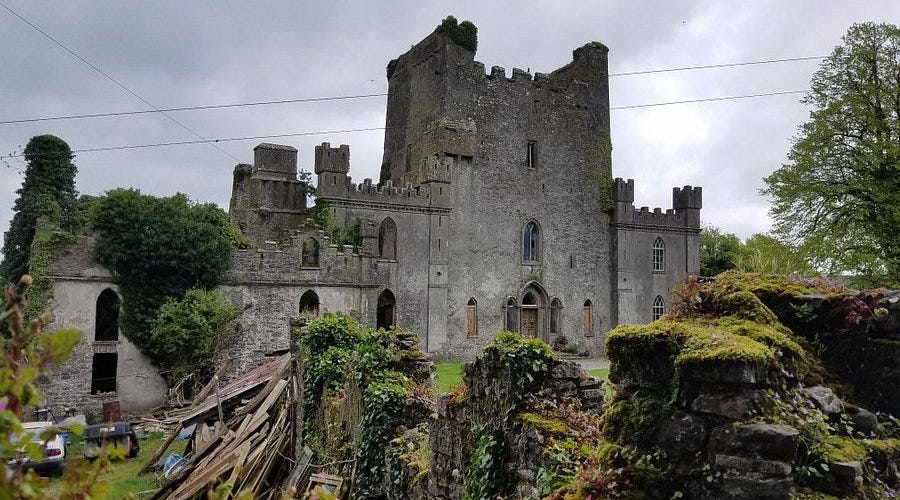
Darby was not born there. He was born in Westminster in 1800 into a wealthy Anglo-Irish family whose interests stretched across England and Ireland, the kind of family in which property, military distinction, politics, and marriage bound one generation to the next. Leap belonged first to his uncle, Admiral Sir Henry d’Esterre Darby, a celebrated naval officer who had commanded HMS Bellerophon at the Battle of the Nile under Nelson. When the admiral died without children in 1823, the castle passed directly to his younger brother John, John Nelson Darby’s father. So this was no crumbling ancestral curiosity last occupied by a Darby two hundred years before, but Leap belonged to the people sitting around John Nelson Darby’s family table.
I’ve seen the transfer in Darby’s own handwriting. In June 1823, the twenty-two-year-old Darby wrote to his older brother, William Henry, at Leap about the legal arrangements their father was executing. The surviving letter is boring, full of deeds, trustees, leasing powers, parcels of land, wine, and family business. While the younger Darby was moving toward the life of religion that would eventually consume him, his father had become the master of Leap Castle, and his brother was already there, handling the estate. Becoming the master of a castle was of generational importance, a matter of status, and considered a responsibility of stewardship.
For an Anglo-Irish landed family like the Darbys, the family castle was almost a sacred inheritance, not just an expensive house. It was the physical embodiment of the family: its antiquity, rank, continuity, land, marriages, military service, and accumulated reputation set in stone. Estates were expected to pass through generations; portraits of the dead watched the living from the walls; family papers accumulated in libraries and strongrooms; and the house gave the family its geographic identity. A London residence might be more comfortable and more frequently occupied, but the ancestral seat answered the more important question of where a family belonged. To inherit Leap was to inherit the Darby name in material form, along with the land and tenants surrounding it and the obligations and prestige attached to both. A man might spend years elsewhere and still understand the castle as the fixed point around which generations of his family revolved.
That is why calling Leap merely Darby’s “ancestral castle” can make the connection sound weaker than it was. In the nineteenth-century landed world, the ancestral seat mattered most symbolically. It connected the living Darbys to dead Darbys and promised that another generation would inhabit the same rooms after them. When Leap passed to John Nelson’s father and then his brother, it remained inside the immediate family line, occupied by his kin. The castle was the family’s monument to its own continuity, a great pile of stone intended to outlive every individual Darby who temporarily called it home.
When their father died in 1834, Leap passed again, this time to William Henry. He took up residence in the castle with his wife, Laura, and their children, Jonathan and Mary Charlotte. The medieval fortress became a Victorian family home without ever ceasing to look like a castle. Old stone rooms and newer additions, libraries and studies tucked into walls built for defense, and servants moving through passages where armed men had once stood watch. One room had been constructed by the admiral to resemble the cabin of his ship, complete with lockers, bookshelves, secret corners, and mysterious little drawers. William Henry made it his private study, filling the old warrior’s imitation ship cabin with books and writing.
His daughter, Mary Charlotte, grew up wandering through it all. Her surviving diary shows a young woman raised amid unusual privilege and enormous intellectual curiosity, traveling through France and Germany, visiting cathedrals, museums, galleries, and churches before returning to the old family seat in Ireland. Leap was not merely a ruin with a famous name. Ordinary life happened there, and ordinary domestic life unfolded inside walls that had already been standing for centuries.
Then William Henry followed his younger brother into the Restorationist movement with John Nelson. His path wandered for a time through a fascination with Roman Catholicism, but he eventually joined the Brethren, took an active interest in their growth, contributed to their literature, and participated in the movement over which his brother exercised enormous influence. Leap Castle had therefore become something stranger than the ancestral home of the man later remembered as the father of Dispensationalism. The Plymouth Brethren were inside the castle now.
William Henry could sit writing theology in the admiral’s old study while his children occupied the rooms around him and visitors passed through the ancient corridors outside. Whatever stories the stones had accumulated remained, for the moment, stories. The Darbys had inherited an old castle and were busy turning it into a Christian home.
Then, in 1852, decades into the growth of Dispensationalism at bizarre prophecy conferences and churches here and there, one of the guests started to hear breathing coming from something unseen in their room in Darby Castle.
SOMETHING BREATHING
For years, the supernatural stories attached to Leap Castle could be dismissed with an easy explanation. Mildred Darby, the eccentric woman who married into the family late in the nineteenth century, became fascinated with spiritualism and eventually wrote publicly about the demons she believed inhabited the castle. A woman holding séances in an ancient Irish fortress is perfectly capable of manufacturing a ghost story. Some have alleged that her claims of hauntedness were the result of a fanciful mind, that she was making it up, or that it was all legend. Unfortunately for that explanation, someone in the Darby family had already written the strange happenings down decades before Mildred was born.
In October 1852, Mary Charlotte Darby was twenty-one years old and living at Leap with her parents, William Henry and Laura, when a visitor named Mr. Barton came to stay. Barton was apparently something of a character, and Mary recorded him telling grotesque stories for amusement, including an episode in which he had carried the severed head of a baby in his pocket to frighten his friends. I found a historian, Crawford Gribben, who wondered if he had an appetite for frightening people, and perhaps that’s a better explanation than supernaturality at Leap. But Mary wasn’t frightened by him, and she initially seemed entertained by him. Then, with Barton present, some strange and inexplicable things began to happen in the castle. He was the first to notice what can best be described as unseen spirits.
On Friday night there were what Mary called “all sorts of queer things.” By Saturday, whatever Barton claimed to be experiencing had escalated enough that Mary recorded him as being “frightened out of his wits.” Some have suggested that castles are just naturally scary places. Timber moved. Doors shifted. Wind found cracks in walls several feet thick and produced sounds impossible to locate in the darkness. A guest already filling his imagination with demons and severed heads hardly needed much assistance from the architecture. That’s their theory. I’d say that someone with such a dark sense of humor as Barton would be the least likely to grow terrified by nothing. But on Monday morning, he came downstairs looking, in Mary’s words, “more dead than alive.” During the night he said he had heard footsteps, followed by “a devilish sort of breathing close to his ears.

Whatever Barton thought had entered the room was no distant knock somewhere behind the stonework. He described something close enough to breathe beside his head while he lay there listening to it. The Darbys could have laughed at their guest and sent him home with another story to tell. Instead, they did something you’ll find really weird; they opened the wall.
There was nothing inside it. Jonathan slept in the room with Barton afterward, and the great supernatural assault was reduced to a door slamming during the night, which they could not explain, but it was better than mystery breathing.
But the weird thing is, the weird things didn’t end with Barton. By the time Anna Stoney spent the winter of 1864 at Leap, its reputation as “haunted” was well known. She was the daughter of James Butler Stoney, an important figure in the Brethren movement and a close associate of John Nelson. Anna lived with the Darbys long enough to experience normal family life, essentially taking up residence, accompanying William Henry to the little Brethren meetings. By Anna’s recollection, stories of something supernatural at Leap were already part of the house. By this time, it seems in the record, most of the family and possibly the community considered spirits at the castle a given; whether part of the charm or not, it’s unclear. They started twelve years earlier and kept going so often that they became well known.
Stoney gives the account in the castle lore of a woman said to have been imprisoned in the castle before throwing herself from the parapet. On a particular February night, the story went, the dead woman could still be heard making the journey again. First came the rustling of a silk dress moving through the gallery, then the sound of the fall, followed by silence. Her account establishes that by 1864, a quarter-century before the famous occult-minded Mildred Darby moved into Leap, people living there knew the castle as a place with a ghost or demonic tradition.
Mildred would eventually “investigate” or dabble in the supernatural and describe an entity that became famous as Leap’s “Elemental.” She did not, however, invent the haunted castle. The family had accepted that as fact while John Nelson Darby was still alive.
JOHN NELSON AS A CHILD
Another story about John Nelson Darby is stranger than what Mary Charlotte recorded in her diary. Darby is staying overnight there on a visit (it was later revealed the story was shared in a conversation about Leap Castle), still in bed but not asleep, when he becomes aware that he is no longer alone. A man is standing in the room; the figure appears hooded, and he says nothing. He simply stands there in the darkness with Darby.
Darby does not flee the room or cry out for help, and according to the story, he responds with words to the effect of, “Take what you want.” The hooded figure crosses to the furniture, comes close to Darby, and takes something. The tale never identifies what he takes. Darby told him to take what he wanted. He took it. The figure then turns toward Darby, apparently acknowledging his permission, and disappears. Whatever was there is suddenly gone, and Darby is left awake in the old house without an explanation for what had just happened.
The account survives by Darby biographer Max Weremchuk. Weremchuk received it from a member of the Exclusive Brethren. The informant did not pretend to know more than he knew. The trail therefore disappears backward after only a few generations of retelling.
What makes the account difficult to dismiss, if someone thinks Darby would dismiss ghost stories, is that he didn’t. Darby inhabited a world in which invisible powers were quite real, evil spirits remained active, supernatural manifestations continued into his own century, and Christians occasionally encountered things for which ordinary explanations were insufficient. More remarkably, Darby did not claim merely to believe that such encounters remained possible. Elsewhere, when asked directly whether demonic activity still occurred in his own day, he gave a short answer.
“Yes.”

Then someone asked how he could recognize it. This time Darby’s answer moved the question out of ancient Palestine and into his own experience. He believed that he had seen it himself.
“I BELIEVE I HAVE SEEN IT”
To Darby, demons, possession, and supernatural manifestations were not just relics of the biblical world. He wrote an entire essay entitled “Demoniacal Possession,” rejected attempts to explain every biblical possession as ordinary disease, and believed the same invisible powers remained active in nineteenth-century Europe. “Witchcraft is not gone,” he wrote while discussing contemporary spiritualism and “spirit-rapping.” Some of it was fraud, certainly, but Darby did not believe fraud could account for all of it.
His understanding of demonic activity was subtler than spinning heads and bodies thrown across rooms. Darby believed evil spiritual powers could act upon both the body and the mind. Under sufficiently powerful influence, he thought, a person might receive thoughts from an external spiritual intelligence while experiencing them as his own. He also believed such activity could occur within religious movements, wrapped in Christian language and accompanied by apparently impressive spiritual manifestations. Darby was no hyper-Cessationist.
During one recorded Bible reading, someone asked Darby whether people could still be demonically possessed. “Yes,” he answered. When asked how such a thing could be recognized, Darby acknowledged that the judgment required spiritual discernment and then quietly crossed the line from theological speculation into autobiography: “I believe I have seen it; but that is a question of my discernment.”
Elsewhere he was more certain. Describing unusual spiritual manifestations, Darby wrote, “I have witnessed such,” adding that the evidence had identified them to him with “the active energy of Satan.” In Somersetshire he recalled being asked to intervene in a bizarre situation surrounding a previously successful evangelist whose behavior had begun disrupting an entire Christian assembly. Darby initially refused even to approach the situation, but eventually worked up the courage. His tentative judgment that first evening was, “I cannot say, but I think it is of the devil.” By the following day he had made up his mind. “I said it was the devil.”

None of this tells us what happened in the bedroom of Leap Castle. It does establish something more useful. The story about Darby encountering a hooded figure did not come from a man who would have considered such an event impossible. John Nelson Darby himself said that he had witnessed phenomena he attributed to Satan and believed he had personally seen what may have been demonic activity. Whatever else we make of the ghost story, the supernatural Darby is not an invention of the ghost story.
THE WOMAN WHO WENT LOOKING FOR IT
John Nelson Darby died in 1882. Seven years later, a young woman named Mildred Dill married his great-nephew, Jonathan Charles Darby, and came to live at Leap Castle. By then the old fortress had accumulated centuries of bloodshed and generations of stories, including the strange events Mary Charlotte had recorded while John Nelson was alive. Mildred did something the earlier Darbys apparently had not. Rather than merely living among the stories, she went looking for whatever might be behind them.
Mildred became fascinated with psychical research, spiritualism, and the possibility that Leap was genuinely inhabited by supernatural entities. She experimented with automatic writing and séances and eventually claimed encounters with something far more disturbing than the melancholy woman of the old family legend. In 1908, writing in The Occult Review, Mildred described what became known as Leap Castle’s “Elemental,” an apparition she portrayed as roughly sheep-sized, with a human-like face, dark cavities for eyes, and a sickening odor accompanying its appearance. Whatever she experienced, imagined, or helped create through years of occult experimentation, Mildred transformed Leap from a castle with ghost stories into one of Ireland’s most notorious haunted houses.
Another peculiarity in Mildred’s biography stood out, in that she had been raised among the Plymouth Brethren. The woman who would eventually conduct séances there and write publicly about encountering an elemental spirit had grown up inside Darby’s Dispensational Cult (I use the term “cult,” not because it was Dispensational, but becuase it was a cult; the Exclusive Brethren, under Darby, fit that definition during its earliest years). This doesn’t mean she picked up her interest in the Occult from the Brethren, to be clear. But she’s not the only one. Aleister Crowley was born into a devout Plymouth Brethren household thirteen years before Mildred arrived at Leap. He also revolted against his upbringing in the Brethren, and once, having been a devout follower when he was younger, having stated, “I could not believe that anyone could not believe it,” ultimately inverted Darby’s Dispensations into an Occult version of it in his Aeons, and fashioned a Satanic faith modeled after Darby’s general premises. I’m not blaming Darby for Crowley. But Crowley definitely borrowed his main ideas.
Mildred was entering a difficult marriage. She was intelligent, restless, and determined to write, while Jonathan - 15 years older - apparently had little enthusiasm for having a novelist for a trophy wife, and she wrote under a pseudonym against his permission. Leap itself soon became one of her subjects. She explored blocked passages, rooms, staircases, and forgotten portions of the structure while experimenting with séances and automatic writing (the spiritualist practice in which a person surrendered control of the pen in hopes that another intelligence would guide the hand). She was no longer merely hearing the old family stories about its hauntedness, but actively searching the castle, physically and psychically, for whatever might be behind them. By 1898 she had begun turning Leap into Gothic literature, disguising it as “Kilman Castle” in a story published in Belgravia. A decade later she published a much fuller account in The Occult Review.
Mildred reported footsteps, screams, sudden pockets of unnatural cold, and female apparitions moving through the castle. Most notorious was something she called the “Thing,” which I mentioned earlier, also called the Elemental. She described a grey, grotesquely proportioned creature with dark cavities around its eyes and something disturbingly human in its face. Its most memorable feature was not its appearance but its smell. Mildred associated the creature with an overpowering stench of decomposition, as though something dead had entered the room before it became visible. In one account, she and Jonathan reportedly confronted the Thing together on the gallery. It was apparently so real that Jonathan’s first reaction was that he thought she was pulling a prank, so he at least saw it and appears to have reluctantly admitted it. He was eager to tone down her claims and didn’t want the attention drawn to the castle as Occultic.
LEAP’S HAUNTED HISTORY
Before returning to the Darbys, it is worth going backward, because calling Leap Castle “haunted” almost trivializes what really happened there. Long before the Darbys reported footsteps in empty corridors or something breathing beside a bed, Leap was a fortress built to dominate a strategic river crossing and the pass through the Slieve Bloom Mountains. It was not designed primarily for comfort. Its thick walls, defensive rooms, dungeons, concealed passages, and commanding position existed because medieval Ireland was violent, and the people who controlled Leap intended to remain in control. By the sixteenth century, those people were the O’Carrolls, and their history at Leap reads less like a family genealogy than a casualty list. A surprisingly early source, Constance Louisa Adams’s 1904 Castles of Ireland, describes large dungeons beneath the keep, bricked-up passages, secret chambers, and a guardroom carved directly from rock.
The violence was already old by then. In 1489, John O’Carroll died of plague at Leap during an outbreak so severe that Adams records hundreds of bodies lying unburied in the surrounding countryside, like a scene from Stephen King’s The Stand. In 1513, Gerald FitzGerald, Earl of Kildare and Lord Deputy of Ireland, marched against the O’Carrolls and attempted to take the castle. Leap held. FitzGerald withdrew to gather a larger force and heavier artillery, but died before he could return. His successor attacked again in 1516 and partially demolished the fortress. Leap survived that too. The castle standing over the pass was already accustomed to siege, disease, death, and rebuilding before the family murders for which it became infamous had even begun.
Then the O’Carrolls began killing one another. After the death of the chieftain Mulrooney O’Carroll in 1532, the question of succession opened a feud within the clan. The most famous killing occurred inside the castle chapel. According to the longstanding O’Carroll tradition, one of the rivals for power was a priest who was celebrating Mass before members of his own family when his brother entered the chapel armed with a sword. The priest was attacked at the altar and died there. Later accounts identify the murdered priest as Thaddeus and his rival as Teige O’Carroll, although the details get hazy in the accounts. The central tradition is that brother murdered brother during Mass, and the room thereafter became known as the Bloody Chapel.
The remarkable thing is how little that murder stands out once the rest of the family history is laid beside it. It was a long, bloody history. Teige O’Carroll was subsequently killed by his kinsman Cahir O’Carroll. Then, in 1554, Teige’s younger brother William killed him. William was then murdered in 1581 by his O’Conor relatives. His son John inherited the position and was murdered the following year by his cousin Mulrony. John’s brother Charles answered that killing by murdering Mulrony and taking power himself. Within a few generations, control of Leap passed repeatedly through bloodshed, with one relative killing another, only to be killed in turn by someone avenging an earlier killing or advancing another claim.
Their enemies and hired soldiers sometimes fared even worse. Leap tradition records that the O’Carrolls occasionally hired mercenaries to eliminate rivals and then discovered an economical way to pay them. One story is that thirty-nine mercenaries from the O’Neills clan who had just “done a job” for them were invited back to Leap for a celebratory feast. Their food was poisoned, and the mercenaries were finished off by having their throats cut, and their bodies were thrown into the castle’s dungeon. Frankly, Darby’s family castle was basically the horror scene of a Rob Zombie film.
In 1599, Charles O’Carroll was fighting against Hugh O’Neill, Earl of Tyrone, and employed MacMahon mercenaries from Monaghan. They fought for him and afterward returned expecting payment and hospitality. The Leap tradition says the men were entertained and then murdered while they slept. Reportedly, Charles O’Carroll had grown suspicious of his own soldiers and, when the time came to pay them, killed approximately 150 of his own men along with MacMahon nobles. Whatever the precise number, Charles did not survive the consequences for long. In 1600, he was himself killed in retaliation. The rhythm of Leap had become almost mechanical: employ men, kill men, avenge men, inherit, murder, inherit again.

See why it took at least three wagons of bones to carry off the dead? Imagine the smell coming out of that place in July, mercy sakes.
The oubliette, or dungeon, was explored in 1904 - while it was still a Darby property - , which is when the human remains came out and were eventually buried in consecrated ground. Mixed among them were pieces of several old watches, meaning those deaths went right up until shortly before the Darbys got it. They found wooden spikes upon which victims supposedly landed after being dropped through the trap above.
But the dungeon was not even the only place human remains appeared. “Numerous bones” had been discovered in different portions of the castle. More human bones had been found in a field near the river below. Beneath the keep were more large dungeons. Inside the structure were sealed passages and secret chambers. The castle had been repeatedly expanded and altered, leaving portions of earlier Leap swallowed inside later construction. Walls could conceal rooms. Floors could conceal shafts. A person living there in the nineteenth century could walk through a comfortable Victorian household every day while entire pieces of the medieval fortress remained closed, bricked over, or forgotten.
That’s why, when Mary Charlotte Darby recorded frightened guests hearing inexplicable sounds, and when the family responded by actually opening a wall to see what was behind it, they were not behaving quite as irrationally as it first appears. Leap really did have things behind its walls. There were blocked passages, hidden chambers, dungeons, and a dungeon full of human remains. In a castle repeatedly rebuilt across centuries, there really might be another room on the other side, and history had already demonstrated that what waited there was not always empty.
If you appreciate my work, please grab a premium subscription. Act now and get a 20% discount. This is how I provide for my family, so I sure appreciate it.
If you don’t do subscriptions, please consider a one-time gift of your choosing by clicking here.


