


I had almost completely forgotten that I wrote this book.
About twelve or fifteen years ago (time flies at my age), I sat down and wrote Reason With Me (On the Doctrine of Election), a short book intended to explain the doctrines of election and predestination to ordinary Christians who either struggled with them, hated them, or had never been given a fair explanation of what they actually mean. I did an audio version that has disappeared into the ether, and thousands have downloaded it. And then life moved on. The book went into my files, I went on to fight approximately seventeen thousand other battles, and I rarely thought about it again.
Then Dinesh D’Souza decided to go on a tirade against Calvinism last week. I assume that’s because hyper-Dispensationalists and Neo-Judaizers are almost always Arminians and, clearly being in those circles, Dinesh picked up another fight for them. The reason for that connection is that Covenant Theology - which they called “Replacement Theology” - and Calvinism go together like peanut butter and jelly. It only makes sense, then, that Dispensational Zionism and Arminianism are also naturally affixed to each other.
John MacArthur and his surviving orbit are the exception to this rule. Being both a Dispensationalist and a Calvinist is the primary thing that made him such a novelty in the evangelical world. That odd pairing is enough to make anyone notable, and had more than a little something to do with his notoriety. If you’ve been in the MacArthur orbit for long, you’ll have a distorted sense of normalcy in which you think it’s not that uncommon to see a Dispensational Calvinist. That’s just the bubble you’re in; in the big scheme of things, it is indeed abnormal.
That detail aside, last week people suddenly started arguing about predestination again thanks to Dinesh’s tweeting. My X feed began filling up with the same objections, arguments, accusations, and Bible verses that dominated a considerable portion of evangelical internet discourse a decade or more ago. Somewhere in the middle of watching the argument unfold, I remembered: Wait a minute. I wrote a whole book about this.
So I went digging through my files, found it, and decided to give it to premium subscribers. I also found the audio-book I had professionally recorded (not my voice) still at Monergism.com, and provided it for you to download from this Substack post.
I should probably explain why I hesitated. Here goes:
I have made no secret of the fact that I am a Reformed Baptist. Theologically, I have not abandoned the doctrines I defended in this book. I still believe that salvation is of the Lord, that faith and repentance are gifts of God, that fallen man’s will is bound to his nature, and that God has mercy upon whom He will have mercy. Those convictions have not changed.
What has changed is that I don’t spend much time fighting about them anymore. Part of that is simply because I have moved on from that particular battlefield. Frankly, I have moved on from generalized theological polemics to a considerable degree. I spent years doing it. I fought the battles I believed needed fighting, said what I believed needed saying, and accomplished enough that I don’t feel some obligation to spend the rest of my life relitigating every evangelical controversy I encountered in my twenties and thirties.
I also stopped using the term “Calvinist” several years ago, around the time most of the Calvinists I knew seemed perfectly happy to leave me behind. The fact is, Calvinists have earned a reputation for being self-righteous, pompous jerks. I’ve always said this was true, not just lately. At Pulpit & Pen, one of the most-read articles was a boring post entitled, “Why Are Calvinists Such Jerks?” I hypothesized why people always say that, and why it was true. That article was one of my best-read, not because it went viral - it didn’t - but because I hit the jackpot with Google SEO. It turns out, people Google that question constantly, and my article would pull up. To me, that’s enough evidence - people are asking the question so often that the. article had millions and millions of views, inching upwards day after day, year after year. The Gospel Coalition even stole the concept in their 2012 post, “Does Calvinism Make People Jerks?”
That does not mean I changed my theology. It means I stopped finding the label particularly useful. I have also made no secret of my belief that much of the contemporary Reformed world is profoundly ill. There is a sickness in significant portions of it, characterized by pietism, self-righteousness, sanctimony, cowardice disguised as gentleness, and an almost pathological need to demonstrate personal righteousness by condemning everyone standing three inches to the right.
There are reasons for that. Historical, cultural, institutional, and theological tendencies have helped produce it. I could write an entire book about those problems, too. Maybe someday I will, but that isn’t what this one is about. The point is that Calvinism is no longer a fight I regularly wage.
That is why I thought twice about publishing Reason With Me here. Most of you did not subscribe because you were looking for another website arguing about Calvinism. You are here because you want to learn about strange corners of history, intelligence and OSINT, Nephilim, Bigfoot, Talmudism, forgotten religious movements, bizarre government programs, obscure documents, and whatever rabbit hole I happen to fall into on a Tuesday afternoon. I like it that way.
But when the subject unexpectedly returned to X and began trending again, I realized there was no particularly good reason to leave a book I had already written sitting on a hard drive. Especially when some of you are now watching these arguments unfold and wondering what all the fuss is about.

So here it is. There is an important disclaimer. I essentially did nothing to this book. I pulled the manuscript from my files and sent it to a contractor to put it into the three major ebook formats for premium subscribers. I did not undertake a new edition. I did not go through it line by line, update every reference, reconsider every sentence, or rewrite it the way I would express these things today. I wrote it nearly fifteen years ago. I am sure portions are dated. I am sure there are things I would phrase differently. I’d probably catch errors if I sat down and subjected it to a serious revision. I didn’t.
What you are getting is basically what I wrote then. It is a snapshot of an argument I was making at a particular point in my ministry, written specifically for ordinary Christians rather than theologians. The book says as much in its preface. I wrote it from a pastoral perspective for sincere Christians who believe Scripture and are struggling with what Scripture appears to say about God’s sovereignty over salvation.
And after looking through it again, I remembered something else. There is a reason this particular theological argument mattered to me so much in the first place, and it has surprisingly little to do with winning arguments about Calvinism: The doctrine of election is good training.
I do not mean merely theological training, although it certainly provides that. I mean that wrestling with God’s sovereignty teaches a Christian something far more fundamental: how to believe the Bible when the Bible says something he does not particularly want it to say. That is a skill every Christian needs.
Everybody wages war against God’s sovereignty in his heart. Maybe the battlefield is salvation. Maybe it is suffering. Maybe it is providence, death, judgment, election, hell, unanswered prayer, or simply the fact that God has not arranged the universe according to our preferences. At some point, every Christian encounters something in Scripture that collides with something inside him. Election tends to bring that collision into the open very quickly.
Our pride does not particularly enjoy the proposition that God gets all the credit for salvation. We desperately want to bring something to the transaction. Perhaps we would never claim that our works saved us, but surely our wisdom had something to do with it. Surely we were perceptive enough to recognize the Gospel. Surely we made the right choice while somebody else made the wrong one. Surely, somewhere in the machinery of salvation, there is a little brass plaque with our name engraved upon it.
The doctrines of grace rip the plaque off the machine. Salvation is of the Lord.
That statement is actually the organizing principle of Reason With Me. The book works through predestination and election; the nature of grace, faith, and repentance as gifts; questions of equality and fairness; the human will; and, finally, the objection that election somehow destroys evangelism. The argument is deliberately cumulative. If salvation is by grace, and grace is undeserved, and faith is God’s gift, then eventually we have to confront the question of whether God owes that gift to anybody.
He does not. That is where our pride starts screaming. But learning to quiet that protest and say, in effect, “Let God be true though every man a liar,” is extraordinarily useful training for the rest of the Christian life. It teaches us that Scripture sits in judgment over us. We do not sit in judgment over Scripture. We do not believe God’s Word after determining that it agrees with our intuitions about fairness, justice, goodness, freedom, or human dignity. We bring those intuitions to Scripture and allow Scripture to correct them.
That was really the challenge I put before the reader all those years ago. Refute the argument from Scripture or submit to Scripture. What we cannot legitimately do is reject a doctrine merely because we dislike the God we think it describes. That habit becomes increasingly important the longer you study the Bible.
And something else happens after a while. The doctrine that initially seemed horrifying becomes beautiful. You begin by grudgingly saying, “Fine. That’s what the Bible says.” Then you begin to understand why it says it. Eventually, what once appeared to diminish the Gospel begins to magnify it.
You realize that salvation does not depend upon whether you were clever enough, wise enough, spiritually perceptive enough, or morally superior enough to make the correct decision while another sinner did not. God did not look down the corridors of time and discover some tiny redeeming quality in you that persuaded Him to rescue you. Grace means precisely the opposite. It means receiving what you did not deserve, could not demand, and could never earn. As I put it in the book, justice is receiving what we deserve, mercy is not receiving what we deserve, and grace is receiving what we do not deserve. Once that sinks in, election stops looking like a horrible doctrine and begins looking like an astonishing Gospel.
There is another reason I decided to give you the book. Reason With Me was never written for scholars. If you are looking for a technical academic defense of Reformed soteriology, other more boring men have written enormous books for that task. This is not one of them. This was written for laymen, skeptics, confused church members, and people who hear “predestination” and immediately begin reaching for objections. That makes it particularly useful for beginners.
It is also the kind of thing you can give to a family member or friend who keeps asking questions. If somebody wants to argue with you about election, you don’t necessarily need to spend six hours reinventing the wheel over text messages. Give them the book. Ask them to read it. Then have the conversation. As premium subscribers, you have my permission to give it to whomever you like (just don’t share it online).
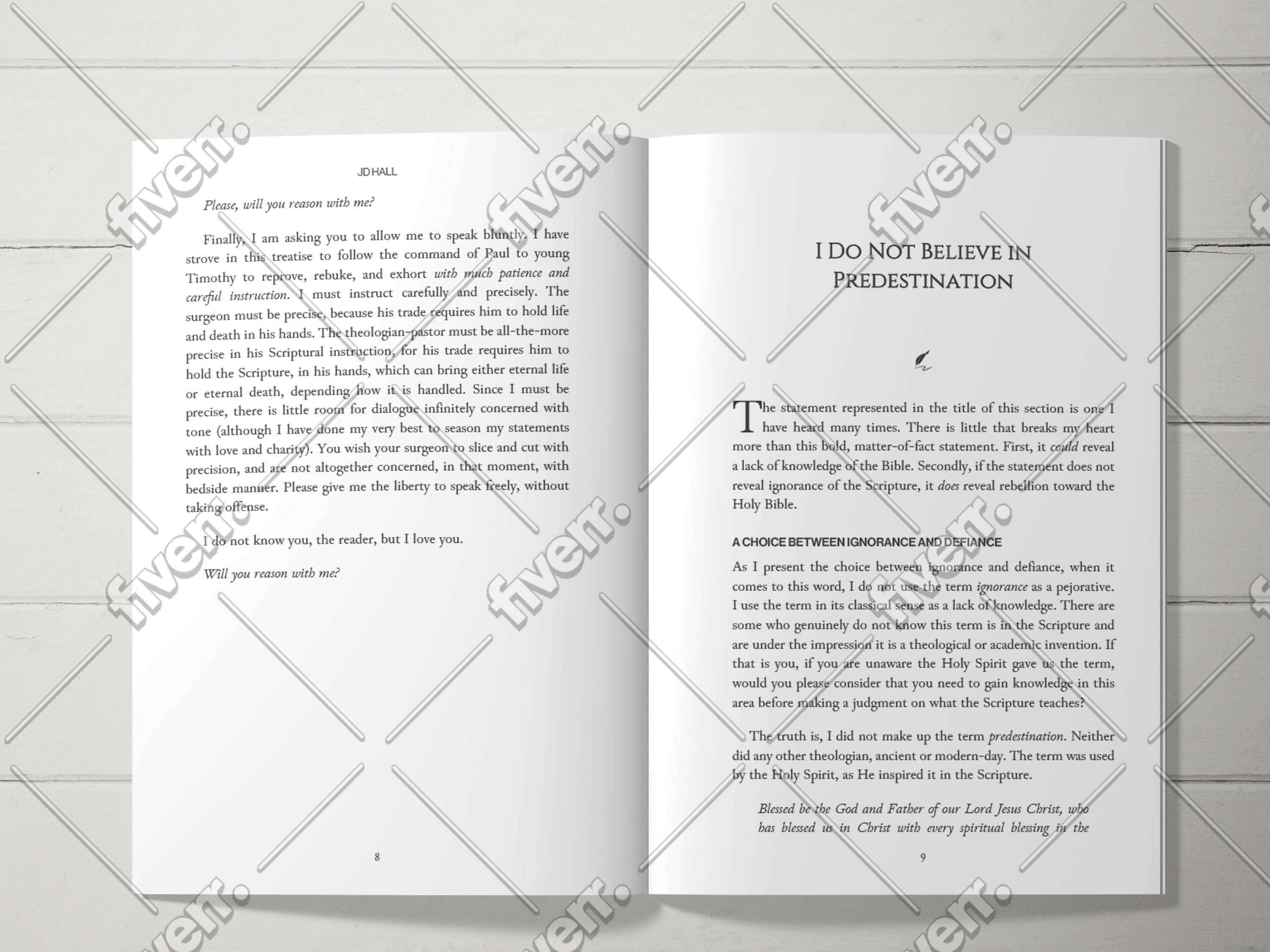
That was the spirit in which it was originally written. I was not asking readers to accept a theological system because Calvin said so, because Baptists said so, or because some collection of dead theologians had voted on it. I was asking them to open the Bible, follow the argument, and decide whether Scripture could refute it. The preface ends with essentially that invitation: put aside tradition, presupposition, emotion, and caricature long enough to ask what God’s Word actually says.
So, all those years after writing it, I am making Reason With Me on the Doctrine of Election available to premium subscribers in the three principal ebook formats.
Take it for what it is. It is an old book retrieved from my files, not a newly revised theological manifesto. There may be things in it I would clean up today, arguments I would sharpen, sentences I would rewrite, and errors I would correct. But the central question has not aged at all.
When God’s Word contradicts something deep inside us, which one gets to win? That question is considerably bigger than Calvinism. Learning to answer it correctly is one of the most important habits a Christian can develop.
So, my question is, Will You Reason With Me? Find the links below.


