


There are moments in every era when the Christian church needs to stop what it is doing, take a very deep breath, and remind itself that truth must not be sacrificed on the altar of sentiment. Right now is one of those moments. The evangelical world has spent the last forty years swimming in a soup of confusion about Judaism, Israel, the Old Testament, the Talmud, and the nature of God’s covenantal dealings. The result is a tangled theological knot that has allowed emotional attachment to a modern nation state to overrule biblical literacy. This environment has birthed a thousand strange doctrines and an entire generation of believers who believe they are honoring Scripture when they repeat slogans crafted more by political lobbies than by the apostles.
Into that confusion stepped someone who should have known better. When Dr. Michael Brown published Christian Antisemitism, he claimed he was defending Jewish people from hatred and misunderstandings. What he actually delivered was a soft, flattering, error filled justification for a religious system that rejects Christ, denies His deity, and stands in direct opposition to the Gospel proclaimed by the apostles. Brown insisted that Christians cannot critique the Talmud without flirting with bigotry. He framed every historic disagreement between the church and Rabbinic Judaism as evidence of prejudice. He used his academic status as insulation, presenting himself as a faithful guide and accusing all critics of violating Christian charity. Far too many evangelicals swallowed the argument without ever cracking open the primary sources

.Someone had to respond. Someone had to take Brown’s claims apart piece by piece and show believers that truth is not hatred and clarity is not bigotry. That is how this book was born. What began as a chapter by chapter review quickly expanded into a full length work because Brown’s errors were not superficial or incidental. They were foundational. They affected every claim, every citation, every historical reference, and every rhetorical strategy that appeared in his book. As the review unfolded, it became clear that a simple rebuttal would never suffice. Evangelicals needed a resource that would tell the truth plainly, without manipulation, without guilt language, and without the soft piety that so often masks capitulation.
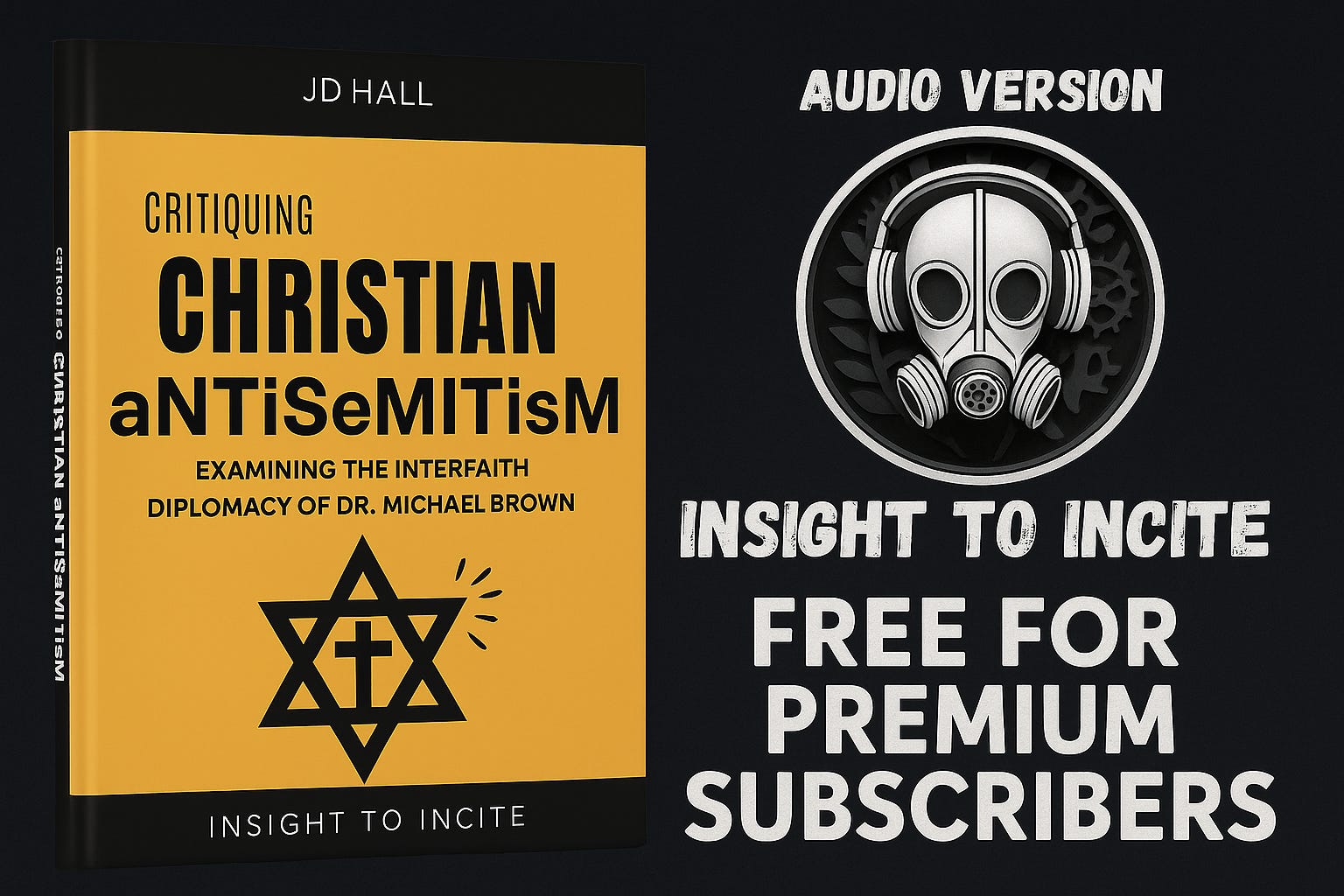
Critiquing Christian aNTiSeMItSm is that resource. It is a direct, careful, documented, and unapologetic answer to the confusion Brown has helped spread. It does not indulge in sloppy rhetoric. It does not rely on emotional language. It does not accuse anyone of bad motives. It simply lays out the facts in a clear voice so that Christians can understand the real difference between Mosaic Judaism and the Rabbinic system that developed after the destruction of the Temple. Those two religions are not identical. They are not two wings of the same tradition. They are not harmonious expressions of the same covenant. They represent different claims to authority, different views of God, and different interpretations of the Messiah. One culminates in Christ. The other rejects Him.
The book explains these distinctions with precision because believers deserve to know why these differences matter. Christians are routinely pressured to treat Judaism as a parallel faith that shares equal legitimacy and covenantal validity. This pressure comes from political groups, interfaith dialogues, evangelical leaders who value applause from elite institutions, and theological systems that elevate the modern state of Israel to near mystical status. In that environment, any criticism of Judaism is treated as hatred. Any historical disagreement is treated as an attack. Any defense of Christian doctrine is labeled antisemitic. That strategy has been successful because modern Christians have not been trained to make careful distinctions. They see only two categories. They see hostility or friendship. They see cruelty or kindness. They do not see the vast space in the middle where truth lives.
Critiquing Christian aNTiSeMItSm walks readers through that space with a steady hand. It gives Christians the biblical, historical, and theological foundation they need to speak about Judaism accurately without bending the knee to guilt based rhetoric. It shows that the apostles understood Rabbinic authority as the enemy of the Gospel. It shows that early Christians confronted the Talmudic tradition with boldness rather than fear. It shows that the church has always recognized the profound differences between the religion of the prophets and the religion of the rabbis. Brown’s attempt to blur those lines is not an act of compassion. It is an act of confusion, and confusion does not produce holiness. It produces compromise.
This book exposes the rhetorical tactics that Brown relies on. He repeatedly redefines key terms, framing all criticism as prejudice and all disagreement as hate. He cites rabbinic sources selectively while ignoring the parts that explicitly reject the foundations of Christian faith. He appeals to his academic credentials as if scholarship itself can settle theological claims. He uses emotional imagery to guilt the reader into silence. These tactics are effective, but they are not truthful. The purpose of this book is to protect Christians from that manipulation by giving them the tools to recognize it. When you know what Scripture teaches and what Judaism teaches, the fog clears. When you understand the history, you cannot be intimidated by rhetoric.
The tone of this book is direct because the stakes are high. When Christians cannot speak truthfully about Judaism, they cannot speak truthfully about the Gospel. The entire structure of the New Testament assumes that Jesus is the Messiah, the fulfillment of the Law and the Prophets, the One who replaced the entire sacrificial system with His finished work. If we cannot say that Judaism rejects Christ, then we cannot preach the Gospel. If we cannot say that the Talmud contradicts the apostles, then we cannot defend the authority of Scripture. If we cannot point out theological error without being called bigots, then Christian doctrine becomes prisoner to the emotional demands of the culture.

This book is not written to provoke hostility. It is written to strengthen clarity. It is written to guard believers who have been taught to feel guilty for believing the New Testament. It is written to bring confidence back to Christians who know that love does not require silence. Truth and charity walk together. Charity does not erase the truth. Any theological system that requires Christians to pretend Judaism and Christianity are compatible is not promoting peace. It is promoting confusion. The only honest dialogue is one that permits both sides to speak without coercion.
Critiquing Christian aNTiSeMItSm is available right now for paid supporters of Insight to Incite. These are the people who make this work possible and who have invested in the mission of restoring clarity in a world that punishes anyone who tells the truth. For now, they alone receive the full e book at no cost. In several weeks, the wider public will be able to purchase it. That window gives supporters early access and rewards the people who have stood behind this work from the beginning. When the general release arrives, it will remain firm, unsoftened, unedited, and completely unapologetic.
If you are a believer who wants clarity about Judaism, if you are a pastor who needs a resource to help your congregation understand the theological landscape, if you are weary of the rhetorical bullying that tries to silence Christians through accusations of hatred, this book is for you. It is written plainly. It is written carefully. It is written to equip. It is written to free the church from the fog of guilt that has settled over these conversations. The modern evangelical world may be terrified of speaking honestly about the differences between Judaism and Christianity, but the apostles were not terrified. The early church was not terrified. Truth does not fear accusations. Truth outlives them.
You can read the full book today by joining the supporters of Insight to Incite. The download is waiting on the other side of the paywall. You will not find a softer version. You will find the truth, delivered without apology, without compromise, and without fear of the crowd.
If you’re already a paid subscriber, you can download the book for free in your preferred format by clicking below. If you’re not a premium subscriber (or don’t want to become one, you can purchase the book here.
