



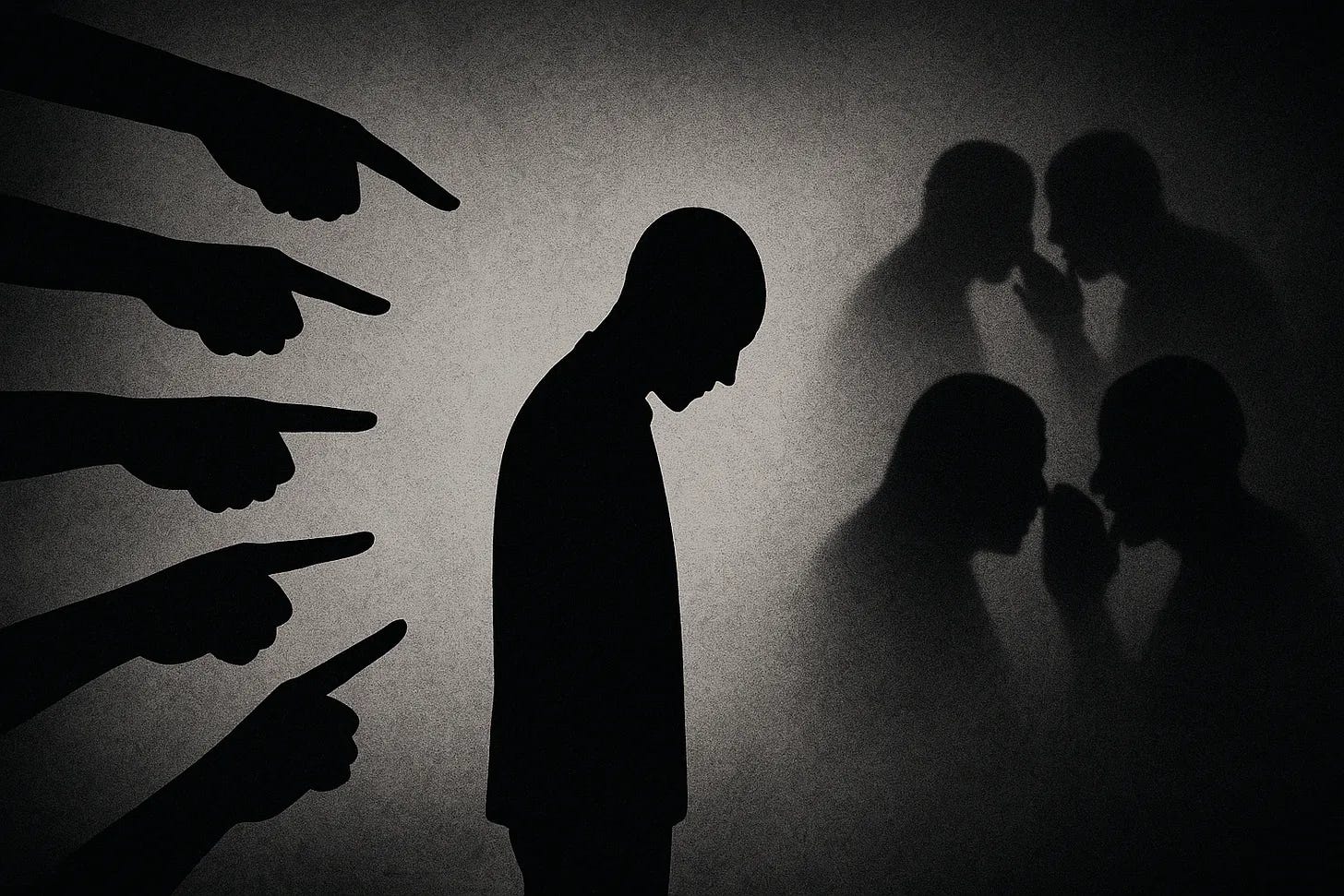
On X yesterday I observed that the latest controversy is what might be called the “denunciation olympics.” The game works exactly as it sounds. Competitors line up to prove their purity by condemning the right enemies in the right order. Each player gains credibility only by showing that he can bark louder, faster, and more aggressively than the man next to him. There are no medals for this sport, no honor, and certainly no joy. The prize is temporary safety, the relief of knowing that the mob is busy with someone else, at least for the moment.
The most recent round began when Corey Mahler, the Internet’s most notorious theological gadfly and anti-Semite, refused to denounce Adolf Hitler. Joel Webbon, who sits higher on the respectability ladder and hosts a polished webcast, declined to denounce Mahler. I, in turn, declined to denounce Webbon for his refusal to denounce Mahler. Because of that, Protestia was called upon to denounce me. When they declined, others demanded that Protestia itself be denounced. The cycle has become absurd. We are now watching guilt by association transform into guilt by refused denunciation, a paranoid soap opera in which the accused is not guilty of a sin but guilty of failing to shout loudly enough against someone else’s sin.
The game does not allow for straightforward questions. Nobody has asked me whether I would denounce Hitler, because that would be too simple. Of course I would, and gladly. The real sport is in demanding that you denounce not the universally hated villain but the man standing just to your left or right, the one who has not satisfied the mob quickly enough. It is about proximity, about showing that you will cast stones in the right direction at the right time. The critics position themselves as the judges of the quick and the dead, and all that is required of us is to bark on command in order to show that we accept their authority.
The power dynamic is very simple. For whatever reason - perhaps emotional trauma, sin, or psychosis - a certain number of men spend their time on an ‘enemies list,’ in an incessant struggle session, listing daily all the reasons their enemies are bad people, documenting micro-aggressions, and reminding the public of their transgressions (no matter how small or distant they may be). Without exception, these are very weak and effeminate men, or masculine women with no real power of their own. But if they can get others to denounce their enemies, not only do they have a new compatriot in their jihad, it morally justifies how they spend their time, and gives them the slightest possible dopamine hit of power, forcing people to agree with them under the threat of similar treatment.
This spectacle is not accountability. It is not discernment. It is not biblical church discipline. It is a loyalty test, and one of the cheapest kind. The test never asks what Scripture says. It only asks whether you will perform the ritual. If you fail, you are guilty by association. If you pass, you buy-in to a protection racket. You refuse, you get the same treatment. That is how mobs function, how tyrants rule, and how fools play at politics. It is not how Christian men should treat one another

THE FUNCTION OF DENUNCIATION IN TYRANNICAL REGIMES
The demand for public denunciations is not new. It has appeared again and again in tyrannical systems throughout history, from revolutionary France to Stalin’s Russia, from Hitler’s Germany to Mao’s China. The practice thrives wherever power must be preserved not by persuasion or truth but by fear.
Denunciation serves several purposes at once. It demonstrates loyalty to the ruling power, not in quiet conviction but in loud performance. It severs bonds of friendship and solidarity, since every man is forced to betray those closest to him. It creates a climate of fear where silence is suspicious and speech must be scripted. And it trivializes truth, since the accuracy of the accusation is irrelevant compared to the zeal of the performance.
These are the reasons why tyrants love denunciation. It does not simply destroy enemies. It destroys trust. It atomizes society into isolated individuals, each afraid of his neighbor. It replaces truth with ritual and reduces justice to the mechanics of fear.
THE SOVIETS, MAO, AND GESTAPO
The Soviet Union provides the most infamous example. Under Stalin, the so-called show trials of the 1930s demanded not only confessions of guilt but also denunciations of colleagues, friends, and family. Refusal to denounce was itself treated as evidence of guilt. Silence meant complicity.
What mattered was not whether the denunciations were true but whether they were loud enough. Witnesses were applauded not for accuracy but for enthusiasm. Defendants were paraded as actors in a macabre theater, required to denounce others in order to prove their own repentance. The system thrived because it was not about justice at all. It was about control, about proving that every citizen belonged entirely to the Party.
The logic of the Soviet trial is echoed in our own theological circles. It is no longer sufficient to preach sound doctrine or to live a godly life. You must denounce the right figure at the right moment, with sufficient zeal, or else be counted guilty. The pattern is the same. Truth is irrelevant. The only thing that matters is whether you will perform the ritual on cue.
The Cultural Revolution in China carried the tactic even further. Red Guards stormed schools, churches, and neighborhoods, dragging professors, pastors, and officials into public squares. The accused were forced to confess imaginary crimes, beat their breasts, and denounce their friends. Failure to denounce others was itself proof of ideological impurity.
The purpose was not correction but submission. By forcing men to denounce those closest to them, Mao severed every bond of trust except loyalty to the Party. Slogans were repeated endlessly, not because they meant anything but because repetition itself was proof of obedience. The entire society was turned into a ritual theater where men survived only by shouting louder than their neighbors.
Again the parallel is obvious. In evangelical social media circles today, orthodoxy is tested not by confession of faith in Christ but by the repetition of slogans. Say the right words, denounce the right villain, repeat the chant loudly enough, and you may survive for another week. Fail, and you are branded suspect. The method is Maoist, whatever the theology pretends to be.
Nazi Germany offers another example. The Gestapo never employed millions of agents. It did not need to. It had millions of informants. Neighbors reported neighbors. Children reported parents. Employees reported their colleagues. Failure to inform was itself suspicious. The result was a society held together not by trust but by terror.
The genius of the system was that it turned ordinary citizens into enforcers. Men rushed to denounce one another first, hoping to prove their loyalty before suspicion fell on them. Fear of denunciation was so pervasive that silence became impossible. The culture of fear functioned as efficiently as an army of secret police.
This too has its echo in our present controversies. Watchdog ministries and online mobs do not need armies of investigators. They need only the threat of public denunciation. Once men are afraid that their silence will be interpreted as complicity, they will begin denouncing one another preemptively. Fear replaces discernment, and performance replaces truth.

THE BLACKLISTS OF AMERICAN MCCARTHYISM
Even in democratic societies the tactic appears. During the McCarthy era in the United States, loyalty to the nation was tested by whether one would “name names.” Refusal to denounce friends or colleagues as communists was itself treated as proof that one was sympathetic to communism. Careers were ruined not by deeds but by silence.
The comparison is not exact, but the mechanism is the same. Guilt by association, fear of silence, and the demand to betray trust in order to survive. The practice corrodes public life wherever it appears.
The evangelical version of denunciation is a parody of discernment. Instead of asking whether a man preaches Christ faithfully or lives in obedience to God’s Word, the mob asks whether he has denounced the right villain, quickly enough and loudly enough. Instead of measuring fidelity to Scripture, it measures fidelity to the crowd.
The substitution is subtle but deadly. What looks like zeal for holiness is in fact idolatry of human approval. What looks like discernment is in fact cowardice dressed up as virtue. What looks like orthodoxy is in fact the repetition of slogans demanded by men who have appointed themselves judges of their brethren.
James warned that the tongue is a fire, set on fire by hell, capable of destroying the whole course of life. When the church makes ritual denunciation its standard, it weaponizes the tongue in precisely the way Scripture condemns. Instead of using speech to edify, it uses speech to destroy. Instead of guarding the truth, it replaces truth with performance.
The cost of this practice is not merely individual reputations. It is the destruction of trust within the church. It is the replacement of biblical accountability with mob discipline. It is the slow habituation of Christians to the logic of tyranny. When men learn to bark on command in order to preserve their own safety, they are already halfway to surrendering the church to the spirit of Antichrist.
CULTIC DENUNCIATION: HOW FALSE RELIGIONS WEAPONIZE LOYALTY
Tyrannies and political regimes are not the only institutions that rely on denunciation. Cults do it as well, and in many cases they do it even more effectively, because they operate on the intimate level of personal trust and spiritual loyalty. The demand to denounce is not incidental. It is central to how cults preserve their power. It is a weapon of psychological control that breaks down individual autonomy, reorients loyalty away from truth and toward the group, and ensures that the leader or ideology at the center remains unchallenged.
From the outside it may look absurd. Why would anyone participate in such a degrading ritual? Why would rational men and women betray their closest friends to satisfy the demands of a leader or group? The answer is that cults operate not on reason but on psychological manipulation, carefully designed to make denunciation feel like survival and silence feel like betrayal. The tactic works because it weaponizes natural social instincts, twisting them into tools of control.
The psychology is straightforward. Humans are social creatures. We crave acceptance, fear rejection, and are deeply influenced by the approval or disapproval of others. Cults exploit this by making loyalty to the group synonymous with loyalty to truth and even loyalty to God. Once the group has become the highest authority, denunciation becomes the necessary sacrifice offered to maintain belonging.
This is reinforced by fear. The fear of being isolated, expelled, or condemned by the group makes individuals eager to preempt suspicion. If refusing to denounce someone makes you look guilty, then denouncing them first seems like the safest way to prove loyalty. Very quickly, members of a group are caught in a vicious cycle. They denounce to protect themselves, which then reinforces the group’s power and creates a culture where silence itself is suspect.
Psychologists who study cults call this “coercive persuasion.” It is a mixture of social pressure, fear of punishment, and the promise of reward. The mind adapts to survive, convincing itself that denunciation is necessary and even virtuous. In this way, the cult transforms what should be seen as treachery into what feels like righteousness.

FALSE RELIGIONS AND THE CULT MINDSET
The use of denunciation is not limited to fringe cults. It appears in larger false religions as well. In Islam, apostasy is punished severely, and members are expected to turn in those who question the faith. In certain strands of Catholic monasticism during the Middle Ages, monks were encouraged to report one another for hidden sins to maintain the purity of the order. In modern totalitarian sects, whether Mormon fundamentalists or New Age communes, the same tactic appears.
The logic is always the same. Loyalty to the group is equated with loyalty to God. Questioning the group is equated with heresy. Silence is equated with complicity. And denunciation is equated with holiness. The psychology is predictable, and the outcome is always destructive.
From the perspective of a cult expert and a polemicist, the most dangerous aspect of denunciation is not simply that it destroys community, though it certainly does. The greater danger is that it destroys integrity. Once a man has been forced to denounce his friends or acquaintances to save himself, he has already surrendered his conscience. He is no longer guided by truth or conviction. He is guided by fear.
At this point, if (for example), Joel Webbon said he wasn’t going to denounce his friends, his critics would raise their shrieking to the sound of a thundering roar, and then denounce him for being friends with the likes of Corey Mahler. That alone would be enough to earn stinging rebukes. And few would feel the hairs on the back of their neck raise and spidey senses go off, as they demand to tell us who we can and cannot be friends with. Thursday, someone told me I should denounce Webbon “for his opinions,” without an ounce of self-awareness of exactly how horrid it sounds to demand one friend denounce another for the sake of contrary opinions. I wondered if I was the only person in that discussion who wouldn’t lose friends over disagreements. Surely God and His Holy Bible would have us value friendship deeper than that, if Christ himself is a friend of sinners.
This is why cults love denunciation. It is not merely a test of loyalty. It is the breaking of the will. It turns men into liars, cowards, and informants. It makes them complicit in the destruction of those they love. It hollows out their souls until nothing remains but obedience. Once a man has denounced his friend, he is fully owned by the group. He has no loyalty left except to the cult.
This is also why denunciation is fundamentally demonic. It takes what God intended for good -trust, friendship, family, loyalty - and weaponizes it into an instrument of fear. It inverts love into betrayal, turning men against one another in the name of holiness. It is a counterfeit religion that mimics the structure of Christian confession and discipline but replaces Christ with the cult and grace with terror.
WHY THE CHURCH MUST REJECT IT
The lesson for the church is clear. The moment denunciation becomes a ritual, we have departed from the gospel. True accountability is rooted in Scripture, carried out with courage, and motivated by love. It does not pit members against one another in a contest of loyalty. It does not demand betrayal as proof of faithfulness. It calls men to repentance and reconciliation, not to public performance and fear.
If the church adopts the tactics of cults, it becomes a cult. If it imitates the psychology of Scientology or the triangulation of Mao’s Red Guards, it has abandoned Christ. We must be vigilant to recognize the counterfeit for what it is. The mob will always demand that we prove our loyalty by denouncing our brothers. Christ demands that we prove our loyalty by loving them in truth. The two paths are mutually exclusive.
Denunciation is one of the oldest tools of tyrants and cults because it works. It works not by persuading the mind but by breaking the spirit. It severs trust, destroys integrity, and hollows out the soul. It turns friendship into suspicion, family into liability, and truth into performance.
False religions rely on it because they must. Without denunciation, members might trust one another more than they trust the group. Without denunciation, families might remain stronger than the ideology. Without denunciation, individuals might cling to conscience rather than fear.
But in the kingdom of God, truth cannot be maintained by fear, and holiness cannot be proven by betrayal. Christians must see through the cultic counterfeit and refuse it entirely. To participate is to be owned by the mob. To resist is to belong to Christ.
If you appreciate my work, please grab a paid subscription to access exclusive content.
If you don’t do subscriptions, please consider a one-time gift of your choosing by clicking the link below. This is one of things I do for my small farm and big family, so I sure appreciate it.


