

A Biblical Multiverse: What String Theory May Reveal About the Unseen Realm
Different scientific multiverse theories exist, but String Theory - in particular - sounds an awfully lot like what the Bible subscribes for us.

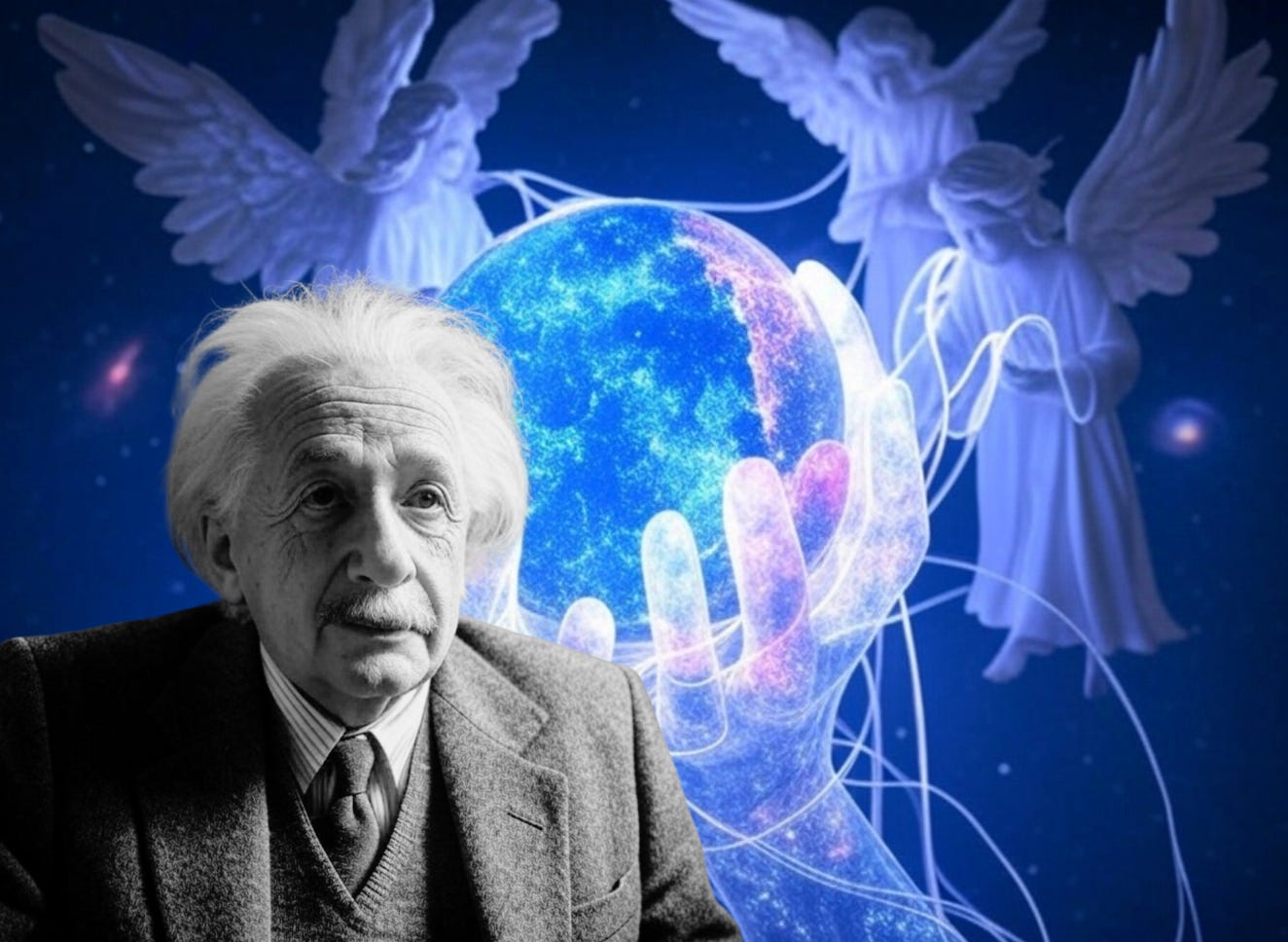
The idea of a multiverse—multiple universes existing beyond or alongside our own—has captured the imagination of scientists and science fiction fans alike. It’s not just one theory but a collection of hypotheses, each rooted in different areas of physics and cosmology.
But before this was a scientific theory, it was a Biblical truth.
A BIBLICAL MULTIVERSE
The Bible presents the unseen spiritual realm as a fundamental aspect of reality—a dimension beyond the physical world that’s inhabited by God, angels, demons, and human souls after death (as well as human bodies, like that of Christ, Enoch, Elijah and one day - all of us). It’s not just a backdrop but an active, influential sphere that intersects with the material world, shaping events and human experience through divine will, spiritual forces, and cosmic order.
At its core, the Bible asserts that God Himself dwells in this unseen realm. In 1 Timothy 6:16, Paul describes God as "who alone is immortal and who lives in unapproachable light, whom no one has seen or can see." This suggests a transcendent domain, beyond human perception, where God’s presence reigns supreme. John 4:24 reinforces this, stating "God is spirit," implying His essence isn’t bound by physicality. The unseen realm is His natural habitat—think of heaven as its centerpiece, often depicted as a place of glory and divine council, like in Isaiah 6:1-3, where God’s throne is surrounded by seraphim crying "Holy, holy, holy." Yet, it’s not just static; Hebrews 11:3 ties this realm to creation itself: "the universe was formed at God’s command, so that what is seen was not made out of what was visible," hinting that the unseen underpins the physical.

Angels and spiritual beings populate this realm, acting as agents of God or, in some cases, His adversaries. Psalm 103:20-21 praises angels as "mighty ones who do his bidding," while Daniel 10:12-13 unveils a cosmic drama where an angel battles a "prince of Persia"—a demonic entity—suggesting a hidden war influencing earthly kingdoms. Ephesians 6:12 drives this home: "For our struggle is not against flesh and blood, but against… spiritual forces of evil in the heavenly realms." This paints the unseen as a battleground, not just a serene heaven, where good and evil contend beyond human sight. Revelation 12:7-9 amplifies this with a war in heaven, Michael’s angels casting out Satan and his followers, who then plague the earth.
The unseen realm also connects to human destiny. In Luke 16:19-31, the parable of the rich man and Lazarus shows the dead existing in distinct spiritual states—comfort with Abraham or torment—hinting at an afterlife realm invisible to the living. 2 Corinthians 5:8 speaks of being "away from the body and at home with the Lord," suggesting the soul enters this unseen domain post-death. Meanwhile, 2 Kings 6:17 offers a vivid glimpse: Elisha prays, and his servant’s eyes open to see "the hills full of horses and chariots of fire"—an angelic army hidden until revealed. This implies the spiritual realm isn’t distant but overlaps with ours, veiled unless God lifts the curtain.
Scripture also frames this realm as a source of power and revelation. Colossians 1:16 declares all things, "visible and invisible… thrones or powers or rulers or authorities," were created by Christ, tying the unseen to cosmic hierarchy. Job 38-41, where God speaks of mysteries like the storehouses of snow or the foundations of the earth, hints at a vast, unseen order beyond human grasp. And in 2 Corinthians 12:2-4, Paul recounts a man (likely himself) caught up to the "third heaven" or "paradise," hearing "inexpressible things"—a mystical layer of the spiritual realm too profound for words.
What emerges is a picture of the unseen spiritual realm as real, dynamic, and purposeful—not a vague ether but a structured domain with beings, conflicts, and divine governance. It’s hidden from natural senses (John 3:6: "Flesh gives birth to flesh, but the Spirit gives birth to spirit") yet impacts the physical, from miracles to moral struggles. The Bible doesn’t map it like a science textbook—its language is poetic, visionary, often mysterious—but it insists this realm is as real as the dirt underfoot, a place where God reigns, spirits move, and eternity unfolds. It’s less about geography and more about presence, inviting faith in what eyes can’t see but scripture affirms.

The concept of a multiverse—multiple universes coexisting beyond our own—has emerged from various corners of physics, each theory offering a distinct lens on reality’s potential vastness. The Quantum Multiverse, the Cosmological Multiverse, the Mathematical Multiverse, and the String Theory Multiverse are all scientific attempts to explain the possibility that is growing among physicists; a belief in a parallel and unseen world that is very real, in part physical, impacts our own physical world, and yet is NOT our physical world.
STRING THEORY
But of all the various theories postulating the Multiverse, it’s the String Theory that appears most plausible to physicists, and is the most popular concept in the scientific status quo. String theory is a theoretical framework in physics that attempts to reconcile quantum mechanics (the physics of the very small) with general relativity (the physics of the very large, like gravity). It proposes that the fundamental building blocks of the universe aren’t point-like particles, but tiny, one-dimensional "strings" of energy that vibrate at different frequencies. These vibrations determine the properties of particles like electrons, quarks, or photons.
A key feature of string theory is that it requires more than the four dimensions we experience (three spatial dimensions plus time). These hidden dimensions could, in theory, influence the physical laws and constants we observe in our familiar four-dimensional spacetime.
In other words, it sounds a lot like what we know about the unseen realm described in Scripture, and how it relates to ours.
If you appreciate my work, consider grabbing a paid subscription for $8 a month or $80 a year to access exclusive content (like the rest of this article).
If you don’t want a subscription, consider a one-time gift of your choosing by clicking the ‘coffee link’ below. This is one of the things I do to support my small farm and big family, so I sure appreciate it.

Keep reading with a 7-day free trial
Subscribe to Insight to Incite: Open Source Intelligence Analysis to keep reading this post and get 7 days of free access to the full post archives.